
Sounding like everyone else used to cost you margin. Now it costs you the mention. You could live with paying more to close a deal. You can't live with not being in the answer your buyer reads. The fix: put something on the page a model can't say without you. A number nobody else has. A position with your name on it. A definition you own.
How big is the gap between the two? A researcher measured it.
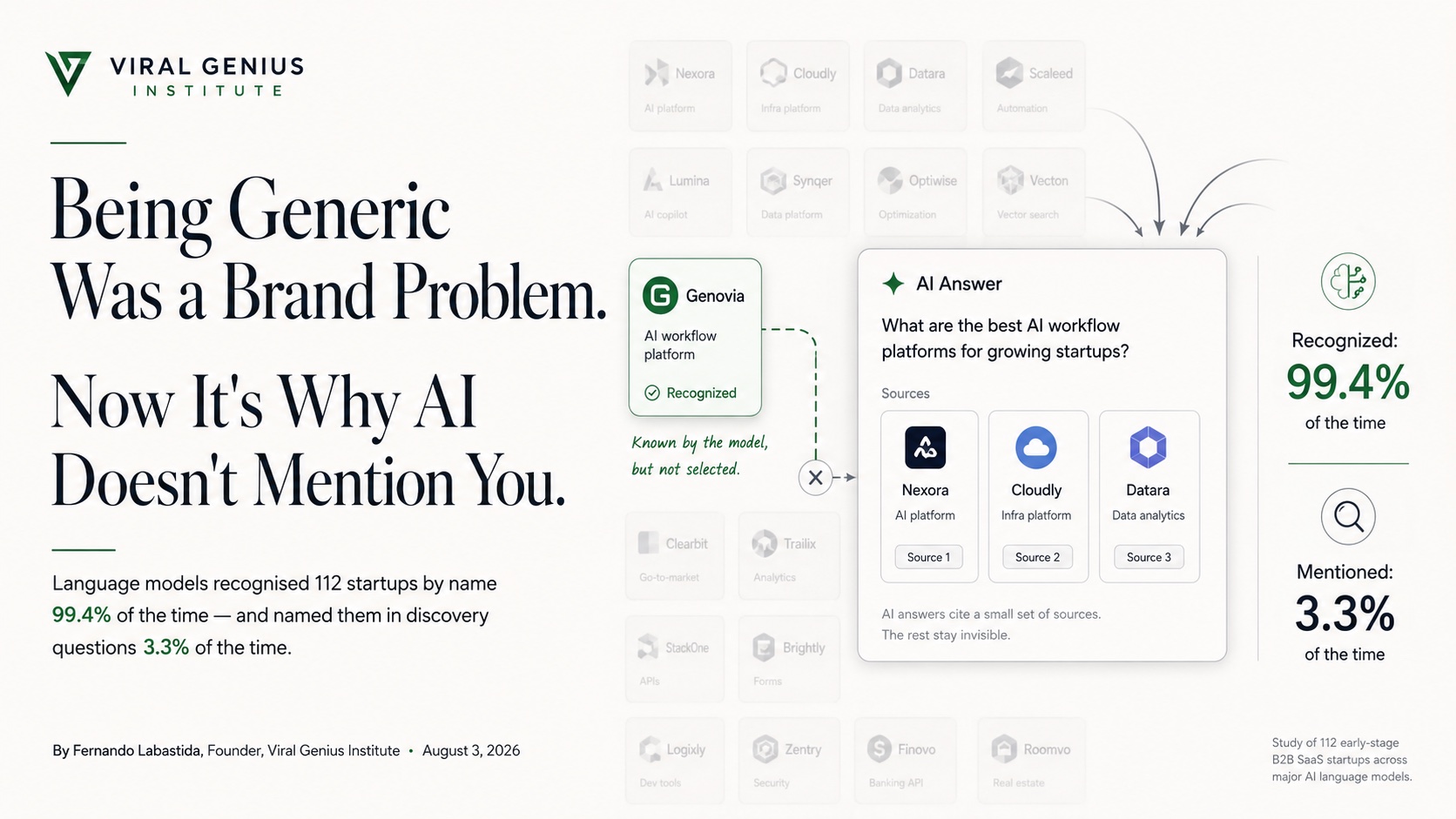
In January 2026 he ran a simple test on 112 startups from the Product Hunt leaderboard. First he asked the models directly, by name: do you know this product? ChatGPT did, 99.4% of the time. Perplexity, 94.3%.
Then he asked the question a buyer would actually ask. Something like what are the best AI tools launched this year? No brand names, just the need.
Those same products appeared 3.32% of the time in ChatGPT. About one time in thirty.
The machine knew they existed. It had no reason to bring them up.
What did sounding generic cost you before AI?
It cost you margin, not customers. Let’s be fair to the old world here, because the marketing science does not back the simple story.
Most of us believe differentiation drives sales. Be meaningfully different, win more customers. Researchers at the Ehrenberg-Bass Institute spent two decades showing that this is mostly false. In work published in the Australasian Marketing Journal in 2007, Jenni Romaniuk, Byron Sharp and Andrew Ehrenberg showed that perceived differentiation between competing brands is low in most categories, and buyers happily buy them anyway. Their conclusion: being distinctive, meaning instantly recognizable through assets like a logo, a color, a name, matters more than being different in what you say.
So sounding like your category did not usually kill you. It showed up somewhere quieter. It showed up in price.
That’s the finding underneath Les Binet and Peter Field’s analysis of roughly 1,000 IPA Effectiveness Award case studies. Long-term brand building reduces price sensitivity; short-term, price-led activation increases it. A company with nothing distinctive to say ends up competing on terms it doesn’t choose. Discounting to close, paying for growth one customer at a time.
That was the deal. Generic was survivable. It made you cheaper, not invisible.
What changed when AI search arrived?
The click stopped being the outcome. Pew Research tracked the real browsing behavior of 900 US adults across 68,879 Google searches in March 2025. Clickstream data, not survey recall. When an AI summary appeared, users clicked a traditional result on 8% of visits. Without one, 15%. Roughly a 47% relative drop. Clicks on links inside the AI summary: 1%.
The number of slots collapsed. Pew also found the median AI summary ran 67 words and cited three or more sources. Three names, sixty-seven words. A results page once offered ten links, and you could be sixth.
Those slots are not evenly distributed. Analyzing 366,087 citations across 24,069 conversations, researcher Kai-Cheng Yang found a Gini coefficient of 0.83 for news sources, with the top 20 sources taking 67.3% of all citations. That is a winner-take-most structure. In a ten-link world, being the eighth-best answer got you a trickle. In a three-name world, it gets you nothing.
And invisibility turned out to be stable. A 2026 study of 102 brands across 102,025 prompt responses found that 77.5% of brand-and-engine combinations were strictly always-mentioned or never-mentioned. The pattern is deterministic. If you’re not being named, you are reliably not being named, and waiting will not change it. That study’s author sells AI-visibility tooling, so read the framing with that in mind. The underlying data is original and disclosed.
Why does a model skip your company?
Because it can already say what you’re saying, so quoting you adds nothing.
If you have ever written a research paper, you know this mechanism from the inside.
You had four papers making the same argument. You cited one. The other three added nothing to what you were building. You knew they existed. You had read them. That was never the test.
The test was whether a source gave you something the others didn’t.
An AI answer works the same way. It is a short piece of writing assembled from sources, under a hard limit on how many it can name. The question it faces at each slot is the question you faced: does this one add anything?
So what’s the machinery underneath? I’ll be careful here about where the evidence stops.
Retrieval systems have penalized redundancy for a very long time. In 1998, Jaime Carbonell and Jade Goldstein published Maximal Marginal Relevance at SIGIR. It’s a reranking rule that scores a candidate passage on its relevance minus its similarity to passages already picked. Its stated purpose is to stop the system choosing a source that adds nothing new. MMR and the methods that came after it are standard in retrieval and multi-document summarization. That’s exactly what an AI answer is. Gather candidates, write a synthesis, cite a handful.
Separately, work presented at ACL in 2023 by Alex Mallen and colleagues showed that language models recall popular entities from memory reliably and fail on long-tail facts. That’s why systems increasingly retrieve adaptively, fetching sources only when the model judges its own knowledge thin.
Put those together and you get the intuition: a system built to avoid redundancy, deciding whether a source adds anything it can’t already produce.
Here’s where the evidence stops. No published study I could find directly tests whether similarity to category consensus reduces citation probability. MMR proves redundancy penalization is a real, named, universally implemented component of these systems. It does not prove that your generically-positioned company is being penalized by it. That step is an argument, not a finding, and a careful reader deserves to be told which is which.
What is measured is the outcome. The discovery gap, the concentration, the determinism. The mechanism is the best available explanation for it.
What actually gets cited by AI engines?
Specifics get cited. Numbers, quotes, and named sources. The research here beats the folklore.
At KDD 2024, Pranjal Aggarwal and colleagues published the first systematic study of generative engine optimization, benchmarking across roughly 10,000 queries in 25 domains. Adding statistics, quotations and citations to sources raised a page’s visibility inside generative answers by up to 40%. Keyword stuffing lowered it.
What do those three have in common? A number, a quote, a named source. All things a model cannot invent and cannot work out from the category. They are, by definition, the parts of a page that are not generic.
Two other findings point the same way. Ahrefs’ analysis of 75,000 brands found branded web mentions correlated with AI Overview visibility about three times more strongly than backlinks did. Being talked about elsewhere beat optimizing your own site. And a 2026 Semrush study of 1,094 US categories found that traditional SEO metrics barely predicted which brand a model named. Owners had more organic traffic in just 48.4% of competitive pairs. A coin flip.
Semrush’s framing is the useful one: AI visibility is won topic by topic. Only 15.2% of the categories they tracked had a clear owner at all. Being known for one specific thing beats being broadly credible about many.
Both are vendor studies with commercial interests. Ahrefs says plainly that its correlations are moderate to weak and shouldn’t be read causally.
What argues against all of this?
Four things, and they’re real. If I only showed you the evidence that agrees with me, you shouldn’t trust any of it.
Most optimization tactics don’t survive testing. A 2025 benchmark called C-SEO Bench tested 54 method-and-domain combinations across roughly 1,900 queries. Only three were significantly positive, and none in question answering. The authors also make a structural point: since impression share sums to one, this is partly redistributive, and per-company gains shrink as adoption rises. My reading is that they tested tactics, meaning whether you can dress up the same content. That is close to the opposite of having something different to say. It’s still a real result, and it cuts at the tactical half of this.
Retrieval comes first, and distinctiveness is downstream of it. A factorial experiment running 252,000 trials across six models found topical relevance and list position dominate which source gets cited. So the accurate claim is narrower than “distinctiveness gets you named.” It’s distinctiveness decides among the candidates already in the running. If you aren’t retrieved at all, none of this reaches you.
Fame may be doing the work. Visibility in that 102-brand study stratified hard by size. 73% for tier-one global brands, 44% mid-market, 11% for small and niche. That is a Matthew effect. It suggests total web presence matters more than how sharply you’ve stated a position.
Buyers may not use AI where this assumes they do. 6sense’s 2025 research found buyers using language models to summarize and synthesize research they’ve already gathered, mid-journey rather than at discovery. If AI is a synthesis layer rather than a shortlist generator, this problem is smaller than the headline suggests. Then again, Forrester found that 94% of business buyers used AI in their most recent purchase, up from 89% the year before.
So what holds up?
Four findings survive. Strip out everything contested and this is what’s left.
Models recognize companies they will not recommend. Answer slots are few and their distribution is severely concentrated. Being mentioned or not is stable rather than random. What correlates with citation is specific, attributable, checkable material. What correlates with being ignored is material a model can produce without you.
This is a new argument, not the old one in new clothes. Ehrenberg-Bass were right that human buyers never much needed you to be different. Retrieval systems are not human buyers. They are systems built to skip the redundant, choosing three names from a field of candidates. Having a real position, and saying something only you can say, may finally pay off. It didn’t used to.
One more thing. Bain and Google surveyed 1,208 people involved in B2B buying and found that 86% arrive with a “Day One list” of suppliers they already intend to consider, and around 90% of purchases come from that original list. Being on the list before the process starts was always the whole game.
AI answers are now where a large part of that list gets assembled.
Which means the old and new arguments converge on the same instruction. You needed something distinctive to say when the cost was margin. You need it more now that the cost is the mention. What changed is the severity. And the penalty now comes from a system that won’t make an exception for you because your work is good.
The mechanics of being retrievable are real and worth doing. We cover them in the Distinctiveness Multiplier. They multiply what you have. If what you have reads like everything else in the sea of sameness, they multiply that instead.
What they’re waiting to multiply is your One Unforgettable Idea: the single idea a founder owns so completely that they stop being compared and become their own category.
Sources
- Sharma, Amit Prakash. "The Discovery Gap: How Product Hunt Startups Vanish in LLM Organic Discovery Queries." arXiv:2601.00912, January 2026. 112 startups, 2,240 queries. Single-author preprint, not peer-reviewed.
- Pew Research Center. "Google users are less likely to click on links when an AI summary appears in the results." 22 July 2025. 900 US adults, 68,879 searches, browsing-behavior data. Google has publicly disputed the methodology; Pew stands by it.
- Yang, Kai-Cheng. "News Source Citing Patterns in AI Search Systems." arXiv:2507.05301, July 2025. 24,069 conversations, 366,087 citations.
- Kumar, Pratyush. "Generative Engine Optimization at Scale." arXiv:2606.20065, June 2026. 102 brands, 102,025 prompt responses. Author is affiliated with an AI-visibility vendor.
- Carbonell, Jaime and Jade Goldstein. "The Use of MMR, Diversity-Based Reranking for Reordering Documents and Producing Summaries." SIGIR 1998.
- Mallen, Alex et al. "When Not to Trust Language Models: Investigating Effectiveness of Parametric and Non-Parametric Memories." ACL 2023.
- Aggarwal, Pranjal et al. "GEO: Generative Engine Optimization." ACM SIGKDD 2024, arXiv:2311.09735. ~10,000 queries across 25 domains.
- Ahrefs. "An Analysis of AI Overview Brand Visibility Factors." 75,000 brands. Vendor research; Ahrefs states the correlations are moderate to weak and not causal.
- Semrush. "AI visibility is a topic-level game: A study of 50,000 brands in ChatGPT." 2026. 1,094 US categories tracked January–June 2026. Vendor research with disclosed methodology.
- Puerto, Haritz et al. "C-SEO Bench: Does Conversational SEO Work?" arXiv:2506.11097, 2025. 54 method–domain combinations, ~1,900 queries.
- Vishwakarma, Rahul et al. "What Gets Cited: Competitive GEO in AI Answer Engines." arXiv:2605.25517, May 2026. 252,000 trials across six models.
- Romaniuk, Jenni, Byron Sharp and Andrew Ehrenberg. "Evidence concerning the importance of perceived brand differentiation." Australasian Marketing Journal 15(2), 2007.
- Binet, Les and Peter Field. The Long and the Short of It. IPA, 2013. Analysis of ~1,000 IPA Effectiveness Award case studies, 1980–2010. Self-selected award entries.
- Bain & Company with Google. "What B2Bs Need to Know About Their Buyers." Harvard Business Review, September 2022. Survey of 1,208 US B2B buyers.
- 6sense. "2025 B2B Buyer Experience Report." 3,986 global B2B buyers. Vendor research. Forrester, "The State of Business Buying 2026," 18,000 global business buyers, January 2026.