

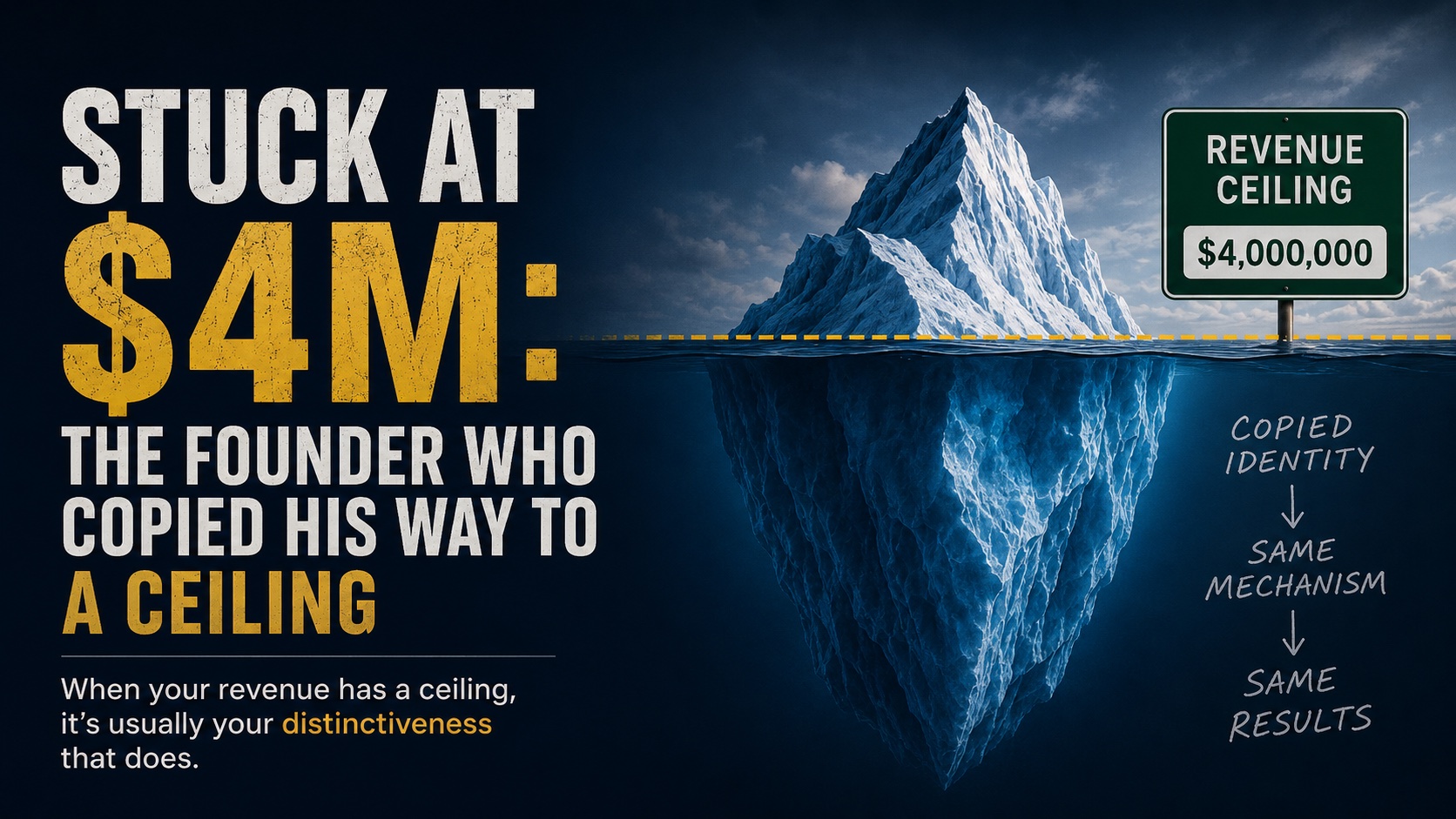
A consultant I spoke with recently described the moment her phone rings. The founder on the other end says some version of this, almost word for word:
“Why have I been stuck at $4 million every year? Why can’t I grow from that? I don’t get it. People love my product. How do we bring in more leads, but we’re not closing?”
Sit with the contradiction inside that sentence. People love my product and I can’t grow are sitting right next to each other, and the founder has no explanation connecting them. That’s the plateau experience: you hold the evidence of quality and the evidence of the ceiling at the same time, and nothing in your marketing education explains how both can be true.
Customers love you. Revenue won't move. Nine times out of ten, nobody can tell you apart from the alternatives. Running the same play harder won't break that ceiling, because the play was never what capped you. The fix is usually something the founder already has and threw in the personal file as irrelevant.
What follows is one founder’s story. A consultant whose team worked with him shared it with me. I’ve changed the identifying details. The pattern I haven’t touched.
The build
He started as a real-estate investor and built a portfolio worth tens of millions. Then he lost it. Effectively all of it.
His own diagnosis of what happened is the most interesting sentence in his entire story: “I lost everything because I didn’t know how to keep my money or protect my money.”
So he taught himself. And he did it on camera while he was still learning, as a student, in public, working it out.
That’s an unusual origin, and it worked. He built an audience in the hundreds of thousands. Fanatical, in the consultant’s word. People who felt he’d been where they were.
The business he built on it was almost comically simple. One course. One product. A weekly live show. One newsletter a month. That was the entire machine, and it produced about $4 million a year.
Then it stopped producing more.
What held him at $4M?
Every month he ran the same webinar. Same structure, same script, executed to the letter. The standard funnel playbook, run with real discipline. It produced six figures a month, and the range moved with something he couldn’t control. The consultant’s description: revenue varied “depending on whether or not his energy was up or low.”
Her phrase for the whole arrangement was “the same revolving door.”
Read that carefully, because it’s the part founders miss. He wasn’t failing. The machine worked. It just couldn’t do anything except what it already did, and its output was pegged to how he happened to feel that month. The ceiling was built into the design.
When the consultant’s team came in, they found the obvious unmonetized asset, a large and devoted audience with nowhere to go, and built him a conference in six weeks. They projected 250 attendees. Around 500 came. Most upgraded on site from the general ticket to the premium one, and he sold a high-end mastermind from the stage. The team took the business from $4 million to roughly $10 million.
Which proves the ceiling was never about effort or audience size. Both were already there. What was missing was a reason for anyone to move.
Is a plateau like this normal?
It’s the normal outcome. You could read this as one guy’s bad luck, and the data says otherwise.
Bain & Company ran a ten-year study of 1,854 public companies across the seven largest industrial economies. Only 9% achieved even their bottom-end growth targets. That was during one of the strongest economic expansions in modern history. Chris Zook, who led that work, put the finding plainly: barely one company in ten manages sustained, profitable growth across a decade.
Nine out of ten businesses hit a version of this wall. If you’re stuck, you are in the overwhelming majority, and the explanation is unlikely to be that you’re uniquely bad at your job.
The second number explains why the wall is there. The 2018 Buyer Preferences Study by CSO Insights surveyed 500 decision-makers worldwide. 68% of buyers reported seeing little to no difference between vendors. Two-thirds of your market cannot tell you apart from the people you compete with.
Put those two findings together and the plateau stops looking mysterious. Most companies stall, and most buyers can’t distinguish between the companies competing for them. Those aren’t two separate facts.
Where did his personality come from?
He took it from someone else. Here’s where his story gets specific.
The persona he presented publicly wasn’t his. He had taken it wholesale, on purpose, from another operator in an adjacent space who was doing well. The look, the archetype, the swagger, the way of talking. The consultant’s words: “his personal identity was ripped off. He took it from someone else.”
And he had a clean, respectable reason for it. The same reason you have heard your whole working life:
Don’t reinvent the wheel. Just copy the next guy. He’s already done it.
That instruction is why this matters beyond one founder. He was not lazy, and he was not a fraud. He was doing exactly what business culture teaches, and teaches for good reason. In operations, copying what works is efficient and sensible. His error was applying an operations rule to his identity, where it doesn’t hold. Nobody told him there was a line, because the advice never comes with one.
This is what we mean by the sea of sameness: a market of indistinguishable companies, produced by diligence rather than indifference. Michael Porter documented the strategic version in 1996. The more benchmarking companies do, the more indistinguishable they become. Sociologists have documented the organizational version since 1983. The mechanism is well-evidenced and almost never named out loud, because naming it means admitting the advice was the problem.
What was he sitting on and hiding?
A whole second life nobody in his audience knew about. Now here’s what should bother you.
This founder had something no competitor could have copied, and he had it the entire time.
He was a serious endurance athlete. Every year he competed in a punishing multi-day desert race, at a level that attracted a national sponsor most people would recognize on sight. And every year he raised six figures for charity doing it.
Nobody in his audience knew. He never showed it. Not on the channel, not in the newsletter, not on stage.
The consultant’s reaction, when she found out, is the whole thesis of this article in one sentence:
“Why aren’t you showing them that? Document that stuff.”
He hadn’t hidden it out of modesty. He had classified it as irrelevant. It wasn’t finance content. It didn’t fit the persona he’d borrowed. So it went in the personal file, while he spent his professional life performing a personality assembled from someone else’s parts.
That is the pattern, and it is close to universal: the unforgettable thing is usually already present and invisible to the person who owns it. Distinctiveness rarely needs to be invented. It needs to be recognized. Founders are the worst-positioned people to recognize their own, because to them it’s just Tuesday.
When can’t marketing fix it?
When the founder no longer believes in what he built. This story doesn’t end cleanly, and I’m telling you the real ending because it’s more useful.
In his late forties he hit something positioning could not fix. Two things had become true and he could no longer avoid either. He would not recommend his own products to his own friends and family. He wasn’t proud of what he’d built, and it had made him a millionaire. He also didn’t much like the customers buying it. He wanted peers rather than beginners.
The consultant told him, in her words: “I can’t help you. You need a therapist. It goes deeper. Now it’s self-identity.”
That’s the boundary of this work, and we’d rather state it than sell past it. The identity ceiling is where a plateau turns from a marketing problem into a problem with how the founder sees himself. There’s a specific, checkable signal. If the founder wouldn’t recommend the product to their own family, no amount of excavation will save the business. Positioning applied to that situation produces a better-articulated version of something the founder already resents.
Excavation surfaces what’s true and distinctive about a business. It cannot make a founder want what they built.
What should you do if this sounds like you?
Three things. If the opening quote was uncomfortable to read, they all follow from his story.
Separate the two kinds of copying. Copying operations is efficient, and you should keep doing it. How a competitor structures onboarding, sequences a launch, runs a sales call. Copying identity gives you a business with no floor of its own. Most founders have never been told there’s a difference.
Look for what you’ve already dismissed. The material is autobiographical and it usually feels off-topic: the expensive failure you learned from, the client nobody else would take, the strange parallel life that has nothing to do with your category. If your instinct is that’s not relevant to my business, that instinct is the thing to interrogate. His was a desert race. Yours is something you’d similarly never think to mention.
Understand that volume won’t rescue you. More reps of an undifferentiated mechanism produce more undifferentiated output, faster. That was true when the constraint was buyers. It’s sharper now that buyers ask AI engines, which is the mechanism we cover in the Distinctiveness Multiplier. A model has no reason to name a company whose position it can infer from the category. Distinctiveness used to be a branding argument. Now it’s a retrieval argument.
The founder in this story had all the hard parts already: the origin, the audience, the trust, the story. What he was missing was permission to believe the interesting thing about him was the thing worth showing.
That’s usually what’s missing. The Viral Genius Institute calls it a One Unforgettable Idea: the single idea a founder owns so completely that they stop being compared and become their own category. It comes out of them rather than from an agency, and it was there from the beginning.
He already had his. Nobody had asked him for it.
This case study was shared with me by Anna Cummins, whose team did the work described — the conference build, the ticket ladder, and the scaling engagement that took the business from $4M to roughly $10M. She has consulted with 7-figure founders for over a decade, running operational audits and 90-day scaling strategies, and publishes at Hello Georgetown. She gave permission for this to be written up and credited. Identifying details of the founder have been changed. The diagnosis, the quotes from Anna, and the numbers from her engagement are as she described them.
Sources
- Zook, Chris and James Allen. Profit from the Core. Bain & Company research: a ten-year study of 1,854 public companies across the seven largest industrial economies found 9% achieved their bottom-end growth targets. See also Bain's ongoing growth research and Zook's "Founder's Mentality" work on complexity as the constraint on sustained growth.
- CSO Insights, 2018 Buyer Preferences Study. Global survey of 500 B2B decision-makers; 68% reported seeing little to no difference between vendors.
- Porter, Michael E. "What Is Strategy?" Harvard Business Review, November–December 1996. On competitive convergence as the byproduct of benchmarking.
- DiMaggio, Paul J. and Walter W. Powell. "The Iron Cage Revisited: Institutional Isomorphism and Collective Rationality in Organizational Fields." American Sociological Review 48, no. 2 (1983): 147–160. On mimetic isomorphism — rational imitation under uncertainty producing homogeneity.