
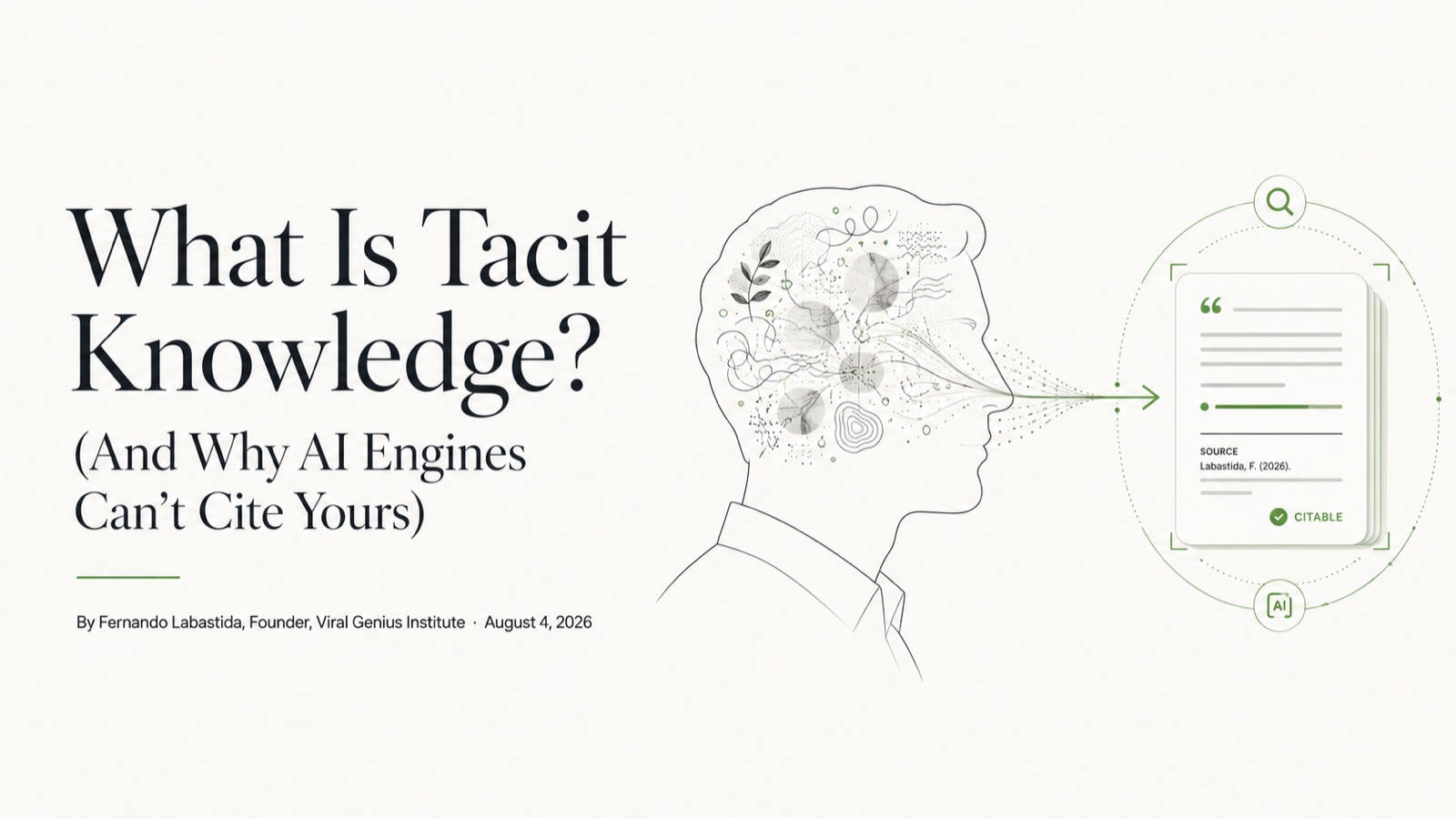
AI engines can only quote what somebody wrote down. The thing that makes you different is usually still in your head, unwritten. Nonaka and Takeuchi named that gap in 1995, and they named the way across it: externalization. The fix: get what's in your head named and published, so the engines have something of yours to find.
Here’s the story that made the idea famous. It starts with bread.
In the mid-1980s, Matsushita’s engineers had a problem no spec sheet could solve. They were building the world’s first home bread machine. The bread kept coming out wrong. The machine kneaded. The dough didn’t care.
So a software engineer named Ikuko Tanaka did something that was in nobody’s job description. She apprenticed herself to the head baker at the Osaka International Hotel, the best bread maker in the city, and kneaded dough beside him for weeks.
What she found was that the baker wasn’t only kneading. He was twisting the dough as he stretched it. He had never mentioned the move, because he had never thought of it as a technique. It was just how his hands worked.
Tanaka brought the “twist dough” insight back. The engineers added ribs inside the machine to copy it. The Home Bakery set first-year sales records for a kitchen appliance.
Two Japanese organizational theorists, Ikujiro Nonaka and Hirotaka Takeuchi, made that story famous in their 1995 book The Knowledge-Creating Company. They gave the phenomenon a vocabulary that business schools have taught ever since.
What’s the difference between tacit and explicit knowledge?
Tacit knowledge is what the baker had: personal, experience-based, hard to put into words. Intuition, judgment, feel. The way a founder sizes up a deal in the first five minutes of a call. Thirty years of pattern recognition that fires before conscious thought does.
Explicit knowledge is what the manual has: formal, systematic, written. Anything that can be stored in a document, a formula, a database. And, crucially for our era, anything that can be retrieved.
Nonaka and Takeuchi’s argument was radical in 1995. Innovation lives in the tacit kind. The companies that win are the ones that convert it into explicit form on purpose. They mapped four conversion modes, the SECI model:
So what did Tanaka actually do, in their terms? Kneading beside the baker was socialization: tacit knowledge moving person to person through shared experience. Naming the “twist dough” move was externalization: the tacit made explicit, communicable, buildable. The manual and the ribbed machine were combination. Thirty years of a baker’s hands became a product spec.
Why can’t AI engines cite what’s in your head?
Because it was never written down, and that’s all they can read. AI search engines are explicit-knowledge machines. Here’s the connection Nonaka and Takeuchi never saw coming. ChatGPT, Perplexity, and Google’s AI answers retrieve and cite what has been written. They cannot interview you. They cannot apprentice beside you. If your best expertise lives only in your head, and for most founders that’s exactly where it lives, it is invisible to the engines by definition. However good it is.
What gets published instead is the explicit part everybody already shares. The Sea of Sameness is what that produces: a market in which competing companies, each following the same widely recommended best practices, become mutually indistinguishable to the buyer. The tacit part, the part that would have separated you, never made it onto the page.
The reverse move is where citation comes from. An engine quotes a source when it adds something the model can’t work out on its own: an original definition, a coined term, a named point of view. Every one of those is an externalization artifact. Swivel-Chair Management, Cloud Convergence, the Continuous Brokerage. Those category names did what “twist dough” did. They made thirty years of tacit pattern-recognition explicit enough for other people, and other machines, to repeat.
Nonaka and Takeuchi even specified the tools externalization runs on: metaphors, analogies, and concepts, drawn out through dialogue. Dialogue, not solo journaling. The baker couldn’t have written a memo about his technique. Someone had to work beside him and ask.
Why can’t you dig this out on your own?
Because you can’t see it. The baker never mentioned the twist because it didn’t feel like a technique to him. It was “just how it’s done.” That’s the exact phrase founders use about whatever turns out to make them different.
This is the trap of tacit knowledge. Its owner is the one person who can’t see it, because to them it looks like common sense. You can’t read the label from inside the jar.
That’s why the Viral Genius Excavation is an interview rather than a workbook. The whole method is SECI run on purpose. Socialization: a real conversation with someone whose job is to notice. Externalization: your genius named, your category coined, your metaphors caught in flight. Then combination: the book, the articles, the summit content, all built from what got said. What Tanaka did for one bread machine, excavation does for a founder’s whole body of knowing.
Your version of the twist exists. It’s been in your hands for years. The question is whether it ever gets a name.
Named, it becomes your One Unforgettable Idea: the single idea a founder owns so completely that they stop being compared and become their own category. Until it does, the engines your buyers now ask first have nothing of yours to find.
- Nonaka & Takeuchi — The Knowledge-Creating Company (Oxford University Press, 1995)
- strategy+business — review of The Knowledge-Creating Company, incl. the Matsushita Home Bakery case
- Nonaka — "A Dynamic Theory of Organizational Knowledge Creation" (paper, via University of Kentucky)
- Wikipedia — SECI model of knowledge dimensions
- ASCN — SECI Model of Knowledge Creation (summary)