
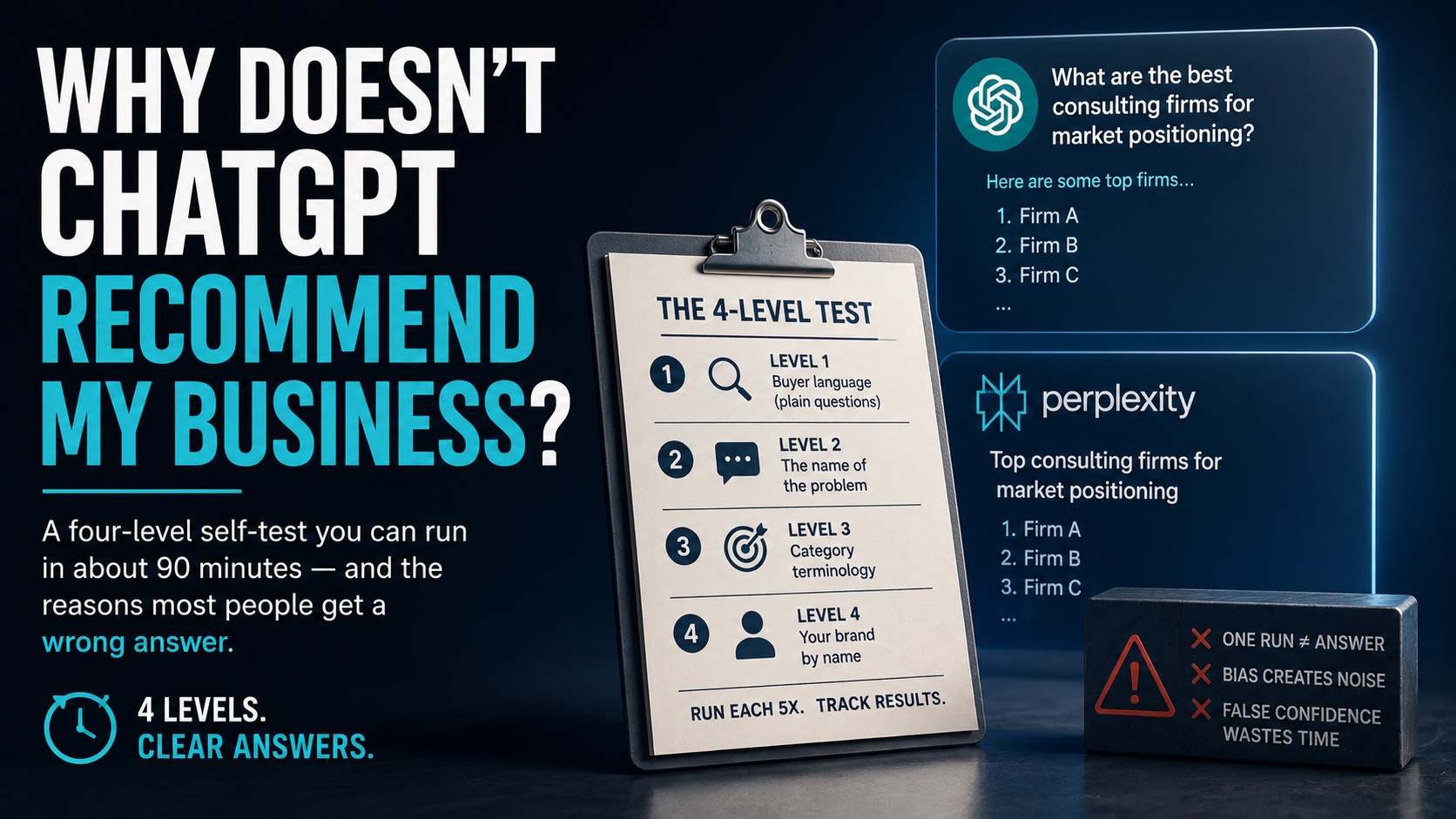
There are four reasons ChatGPT doesn't recommend you, and from the outside they look identical. The engine can't reach you. It can reach you but you're never in the running. It reads you and finds nothing worth quoting. Or it knows you by name and never volunteers you. Each one has a different fix, and applying the wrong one costs you a quarter. The test below tells you which you have in about ninety minutes.
Ever been handed a checklist of technical fixes when your technical setup was already fine? Or told to write better content when the real problem was a firewall rule?
Most advice on this answers a question you didn’t ask. That happens because one symptom has four causes. You type your category into ChatGPT, your name doesn’t appear, and the experience is identical in all four cases. What’s happening underneath is not.
What are the four causes?
Four things have to go right between a buyer’s question and your name showing up in the answer. Break any one of them and the result looks identical from where you’re sitting.
Cause 1: the engine can’t reach you. Firewall and bot rules run before robots.txt is read, so a CDN setting overrides anything you wrote in that file. Cloudflare began asking new domains at sign-up whether to allow AI crawlers in July 2025, and from September 2026 will block training and agent crawlers by default on ad-displaying pages for new domains. Their documentation notes that blocking “training” can also catch multi-purpose crawlers. Plenty of companies are invisible because of a checkbox nobody remembers ticking.
Cause 2: you’re never in the running. Retrieval is the gate, and it mostly still means ranking. Analysis by AirOps with Kevin Indig across 16,851 queries found citation rates of 58% at retrieval position one against 14% at position ten. seoClarity’s study of 362,000 AI Overview-triggering queries found 94% cite at least one URL from the top 20 organic results. The usual reason a good company misses this gate is vocabulary. You rank for what your industry calls the thing. Buyers type what the problem feels like.
Cause 3: you get read and passed over. This is the one nobody expects, because from the sources list it looks like success. Semrush’s study of 1,094 categories found the most-cited domain was also the most-mentioned brand in only 21% of them. Your page can be reference material for an answer that names a competitor. That happens when a page explains a topic competently and states nothing anyone would attribute to you.
Cause 4: it knows you and won’t volunteer you. In January 2026 a researcher tested 112 Product Hunt startups. Asked by name, ChatGPT recognized them 99.4% of the time. Asked the question a buyer actually asks, those same products appeared 3.32% of the time. Recognition and recommendation are separate assets, and most founders check the wrong one.
Why does one test run prove nothing?
Because the same prompt gives different answers every time. This is where most self-diagnosis falls apart, so give me ninety seconds.
Researchers at Thinking Machines Lab ran one identical prompt 1,000 times at temperature zero, the setting supposed to make output deterministic. They got 80 distinct responses, the most common appearing 78 times. All 1,000 matched for the first 102 tokens, then diverged. The cause was batch-size variance under changing server load. Your answer depends partly on how many other people were asking something at that moment.
Peer-reviewed work in ACM Transactions on Software Engineering and Methodology found the same across 829 coding problems. Temperature zero does not guarantee determinism, and on one benchmark 75.76% of tasks produced no two identical outputs across repeated identical requests. The authors call single-run results a threat to conclusion validity.
So if you once typed your category into ChatGPT, didn’t see your name, and drew a conclusion, you drew it from noise.
Four setup rules follow:
- Memory off, or a temporary chat. ChatGPT references saved memories and past conversations, and the behavior differs by plan. Months of discussing your own company means you’re testing your relationship with the assistant.
- A fresh conversation for every query. Earlier turns prime later ones. Ask the branded question after the category question in one thread and the second answer is contaminated.
- Run each query five times, ten if you can. You’re counting how often you appear, rather than whether you appeared.
- Decide whether web search is on, and test both. One study of 20,000 responses found recommendations changed 80.2% between search-enabled and search-disabled modes. Search off tests training data. Search on tests what the engine can fetch now. A page you published this quarter cannot be in the training data.
How do you run the four-level test?
Run four kinds of query, five times each, in fresh chats with memory off. The pattern of hits and misses identifies your cause.
Level 1. The words your buyers use. Plain language, no jargon, no brand names.
“My [specific situation]. Who should I hire?” “What’s the best way to [outcome they want]?”
Level 2. The name of the problem. If you’ve named the failure mode your work exists to fix, test the name. We’ve named two: the sea of sameness and Frankenstein Marketing. There’s no search volume behind a coined term until it catches, which is the point. Whoever owns the name of the problem gets attributed when anyone asks about it.
Level 3. Your category’s terminology. Analyst language, the phrase on your capabilities deck. Worth running because only 15.2% of 1,094 tracked categories had a clear owner in ChatGPT. Most are unclaimed, and ownership was more available in narrow categories (19%) than in high-volume ones (11.3%).
Level 4. Your own name. “What is [your company]?” This checks whether the engine can resolve you as an entity at all, and whether what it says is accurate.
What does your result mean?
| What you see | The cause | The fix |
|---|---|---|
| Nothing at any level, including your own name | The engine can’t reach you | CDN bot settings first, then robots.txt. Mechanics before messaging. |
| Levels 3 and 4 land, Level 1 is empty | You’re not in the running | You’ve positioned in vocabulary nobody searches. Write in the market’s words and link back to the category term. |
| Level 1 lands among five other names, nothing above it | Nothing worth quoting | The gap is upstream of content. There’s no specific claim, number or position to attribute to you. |
| Level 4 lands, everything else is empty | Known, never volunteered | You’re recognized rather than recommended. Give the engine something it can’t say without you. |
Match your pattern to one of the four rows above. The fourth row is the most common result and the most misread. Founders run the branded query, get a flattering paragraph back, and conclude they’re fine.
Which results look worse than they really are?
Your page is new. Citation takes time. Even on a high-authority domain, ChatGPT Search cited only 8% of newly published pages within 24 hours, rising to 42% at thirty days. On a new, low-authority domain, nobody has measured it. So don’t test something you published last week and decide your positioning failed.
You tested one engine, once. Weekly drift in cited domains runs about 5% in Google AI Overviews, 56% in AI Mode, and 74% in ChatGPT Search. A single negative in AI Overviews means something. A single negative in ChatGPT Search means almost nothing.
How do you fix cause three?
Put something on the page a model can’t say without you. Causes one and two have known remedies: unblock the crawlers, rank for the question. The mechanics are here.
Cause three is different, and the evidence on it is unusually clear. Work presented at ACM SIGKDD 2024 benchmarked nine optimization methods across roughly 10,000 queries in 25 domains. The winners were adding statistics (+25.9%), quotations (+27.8%) and citations to sources (+24.9%). Keyword stuffing performed worst.
What do those three share? A number, a quote, a named source. All things a model cannot generate and cannot work out from the category.
There’s older machinery underneath. In 1998, Jaime Carbonell and Jade Goldstein published Maximal Marginal Relevance at ACM SIGIR, a reranking rule that scores a passage on relevance minus its similarity to passages already chosen. Its stated purpose is to stop a system picking a source that adds nothing new. Those methods are standard in retrieval and multi-document summarization. Which is exactly what an AI answer is.
Separating argument from finding here, because it matters. MMR proves redundancy penalization is real, named and universally implemented. It does not prove your generically-positioned company is being penalized by it. That step is an inference.
Google’s own guidance points the same way without needing the inference. Its generative-AI optimization guide tells site owners to skip AI-specific files and markup, then says what to do instead: don’t just recycle what others have already said, or what could easily be produced by a generative AI model.
That’s the engine describing its own selection rule.
What can’t this test tell you?
Whether anyone else gets the same answer you did. Everything above measures your result, on your account, in your location, on one day. Results differ by market. I could find no rigorous work isolating geography’s effect on brand recommendations specifically, so treat that as a plausible confounder rather than a finding.
The four-cause structure is ours. It isn’t an industry standard and it has no published validity study. It comes from watching one symptom get four different wrong prescriptions. And you can prove me wrong. Run the four levels. If your pattern doesn’t match one of the four rows, the model is wrong.
What it does reliably is turn “nobody can find me” into a specific question with a specific answer. That’s more than most companies have when they start.
Whichever row you land on, the work underneath is the same. You need a One Unforgettable Idea: the single idea a founder owns so completely that they stop being compared and become their own category. The four causes tell you what’s blocking it from being seen. They don’t supply it.
Sources
- He, Horace and Thinking Machines Lab. "Defeating Nondeterminism in LLM Inference," September 2025. 1,000 runs of an identical prompt at temperature 0 produced 80 distinct completions.
- Ouyang, Shuyin, Jie M. Zhang, Mark Harman and Meng Wang. "LLM is Like a Box of Chocolates: the Non-determinism of ChatGPT in Code Generation." arXiv:2308.02828; ACM Transactions on Software Engineering and Methodology. 829 problems across three benchmarks.
- Aggarwal, Pranjal et al. "GEO: Generative Engine Optimization." ACM SIGKDD 2024, arXiv:2311.09735. ~10,000 queries across 25 domains. Peer-reviewed; tested largely against a constructed engine rather than production systems.
- Carbonell, Jaime and Jade Goldstein. "The Use of MMR, Diversity-Based Reranking for Reordering Documents and Producing Summaries." ACM SIGIR 1998.
- Sharma, Amit Prakash. "The Discovery Gap: How Product Hunt Startups Vanish in LLM Organic Discovery Queries." arXiv:2601.00912, January 2026. 112 startups; 99.4% name recognition against 3.32% discovery mention. Single-author preprint, not peer-reviewed.
- Semrush with Kevin Indig. ChatGPT topic authority study, July 2026. 1,094 US categories; 15.2% with a clear owner; 21% overlap between most-cited domain and most-mentioned brand. Vendor research with disclosed methodology.
- Semrush. How fast AI platforms cite new content, December 2025. 81 pages on an Authority Score 84 domain; the authors state findings may not apply to lower-authority sites.
- AirOps with Kevin Indig. "The Fan-Out Effect," April 2026. 16,851 queries, 815,484 scoring rows.
- seoClarity. AI Overview rankings overlap, October 2025. 362,000 US desktop queries.
- SISTRIX (Johannes Beus). AI citation drift, May 2026. 82,619 prompts, 1,548,213 snapshots, 6 countries, 17 weeks. Vendor research.
- Visibility Labs. ChatGPT product recommendations with and without search, 2025. 1,000 prompts × 10 runs × 2 conditions = 20,000 responses. Vendor research; covered by Search Engine Land.
- Cloudflare. "Content Independence Day," July 2025. Default crawler policy for new domains. Cloudflare sells bot management.
- Google Search Central. "Guide to Optimizing for Generative AI Features," updated July 2026.
- OpenAI. Memory FAQ. ChatGPT references saved memories and past conversations; behavior varies by plan.