
Books
The Startup Book
How to Write a Book That Designs a New Market Category & Positions You as The Leader
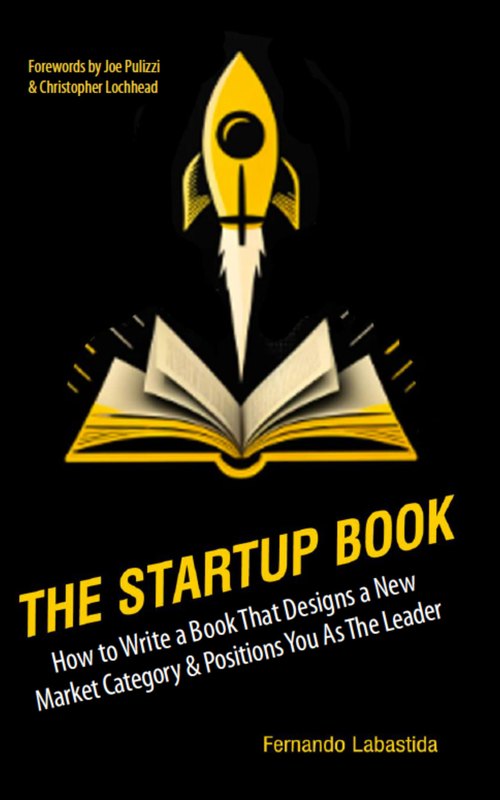
A Startup Book is a book that designs a new market category and makes the market adopt its name. The term is mine. The pattern is old. Peter Drucker's books built the practice of management, Seth Godin's built permission marketing, and Joe Pulizzi's Get Content, Get Customers built a content marketing industry that reached $413.2 billion by 2022. In each case the book came first and the category followed.
Why did I write this book?
I was laid off from a software sales job in January 2009 and started blogging to find clients. Somewhere in that search I found the term content marketing, then found Joe Pulizzi's site, then bought Get Content, Get Customers.
I read it in 2009, two years after it came out, and I assumed content marketing was already an established discipline. It wasn't. Joe and his co-author Newt Barrett had struggled to find enough examples to put in the book. The book was so authoritative that it made a field exist by describing one.
That is the move. The Startup Book is the instruction manual for it.
What's actually in it?
Eleven chapters, in the order a founder would work through them. The Viral Genius Institute treats chapters one and two as the core argument and the rest as execution.
| Chapter | What it covers |
|---|---|
| 1. Designing Your Category | What category design is, obvious versus non-obvious categories, and how to design one. Interview with Christopher Lochhead. |
| 2. Write Your Startup Book | Why it has to be a big-idea book. Interview with Joe Pulizzi. |
| 3. AI-Assisted Book Writing | Outlining, research, assembling a draft, and combining machine and human edit rounds. |
| 4. The 4D Book Method | How one manuscript becomes four dimensions of marketing and revenue. Interview with Bryan Eisenberg. |
| 5. Launching to Best-Seller | Launch timeline, and why social proof is the point of the ranking. |
| 6. Cold Outreach the Startup Book Way | The category-driven, value-first approach in five steps. |
| 7. Speaking Gigs | Four steps to getting on stages. Interview with Ann Handley. |
| 8. The Newsletter for Your Category | The newsletter as education vehicle and as sales vehicle. |
| 9. Social Media the Category Design Way | Posting in service of the category rather than the algorithm. |
| 10. Advertising the Startup Book Way | Paid distribution for a book that has a job to do. |
| 11. Where to Go from Here | What happens to Startup Books next. |
Who is in the book?
Christopher Lochhead, co-author of Play Bigger and The 22 Laws of Category Design, and Joe Pulizzi, who created the content marketing category and founded the Content Marketing Institute, both wrote forewords and both sat for interviews.
Bryan Eisenberg and Ann Handley are interviewed as well. Eisenberg's line from that interview is the one I have built most of my current thinking on: they who control the vocabulary, control the industry. He said it about market perception. It now describes what a machine retrieves.
Where does the Viral Genius Framework fit?
The Startup Book is the writing half. The Viral Genius Framework is what came after, once it was clear that the hard part isn't the manuscript. The hard part is excavating the idea worth writing about, which most founders already have and cannot see.
That's why the Viral Genius Institute now starts every engagement with the Excavation rather than with an outline.
Where can you get it?
The Startup Book on Kindle →
The Startup Book in paperback →
Would you rather start with your own category?
The free Profile. Twelve questions, about fifteen minutes, spoken out loud. You'll get back a plan that names your genius and drafts your category in your own words.
Start talking — free, 12 questions, ~15 minKnow a founder sitting on a gold mine he isn't exploiting?
Send him this page. That's how nearly every client of mine has arrived.