

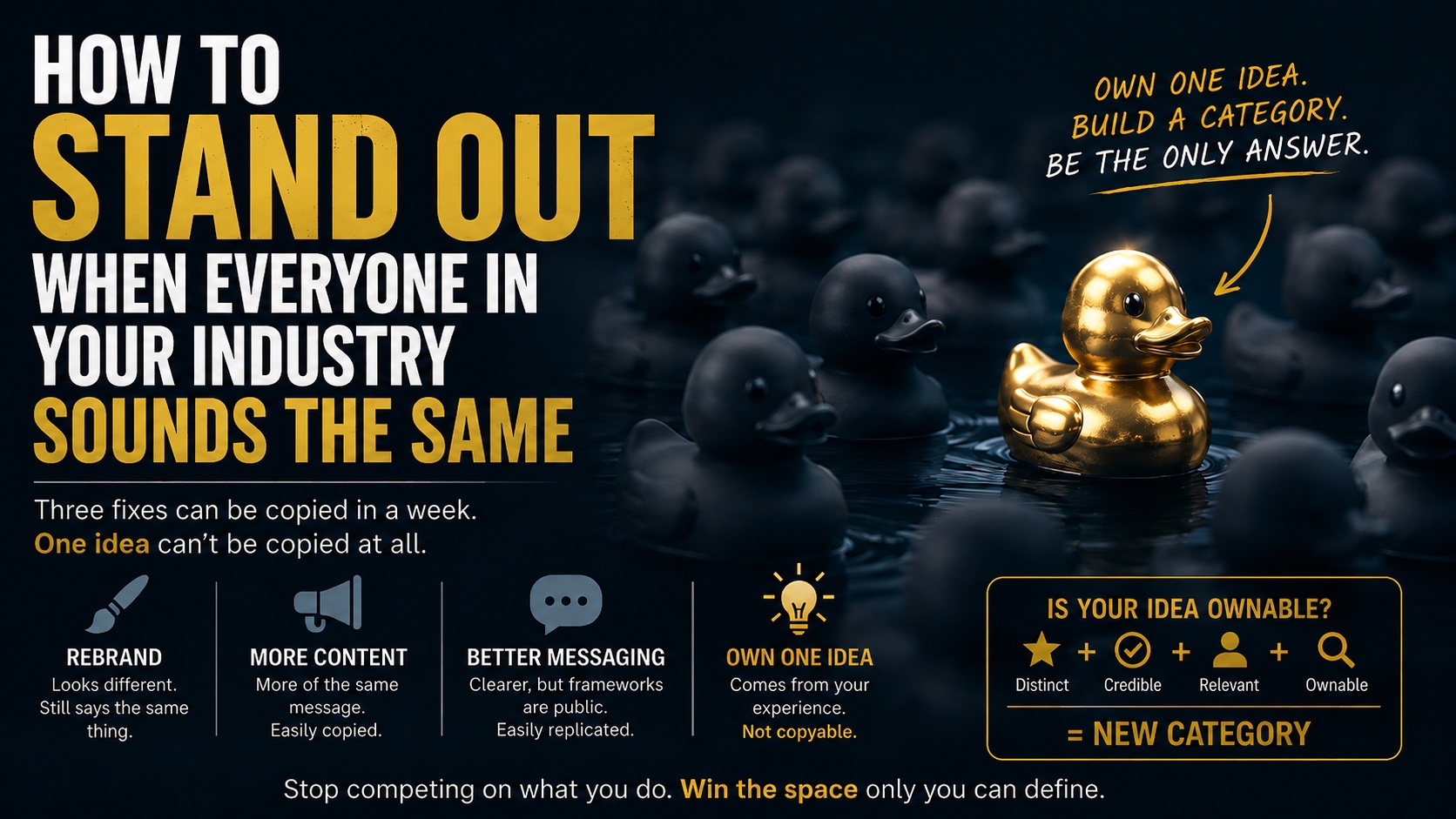
Standing out is not a design problem or a volume problem. Companies try four things when they can't get noticed. Three of them can be copied by a competitor in about a week, which is exactly why they stop working. The fourth is owning one idea that came out of your own experience, and building a category around it. That one can't be copied, because your competitor didn't live it.
A founder told me last month that his agency had “tried everything” to get noticed.
I asked what everything meant. New website. New logo. Three posts a week for a year. A messaging workshop with a well-known consultant.
Four real efforts, real money, eighteen months. And the honest scoreboard: his best clients still described him with the same sentence they’d use for two of his competitors.
Here’s what nobody told him. Three of those four things were copyable the day he finished them.
What are you actually trying to fix?
You’re trying to stop being interchangeable. That’s a different problem from looking dated or publishing too little, and it’s why the usual fixes underperform.
Gartner research found that 64% of B2B customers can’t distinguish one brand’s digital experience from another’s. Two-thirds of your market looks at you and your closest competitor and sees one company.
So what is that number measuring? Whether anyone can tell you apart. It says nothing about whether your site is attractive.
So the test for any fix is simple. Can a competitor do the same thing next week?
| What companies try | What it actually fixes | Can a competitor copy it? |
|---|---|---|
| Rebrand: new logo, palette, website | Looking dated | Yes. A design sprint. |
| More content: post daily, add channels | Not enough surface area | Yes, instantly, with AI |
| Better messaging: run a framework, rewrite the copy | An unclear message | Yes. The frameworks are public by design. |
| Own one idea, build the category | Being interchangeable | No. It came out of your experience. |
The first three are worth money. None of them is a moat.
Does rebranding make you stand out?
Rarely, because your buyers were never confused about your colors. A rebrand changes how a company looks and leaves what it says untouched, and sameness lives in what gets said.
Rebrands earn their keep in one situation: the company genuinely changed and its look is now lying about it. That’s a real problem and worth fixing.
But if the strategy hasn’t moved, a rebrand is a new outfit on the same sentence. Your competitor hires a good designer too.
Why doesn’t publishing more content make you stand out?
Because volume multiplies whatever you already sound like. It doesn’t add anything new.
If what you say is distinct, more of it spreads that. If what you say is what everyone says, more of it produces more sameness, faster and cheaper than before. Anything multiplied by zero is still zero.
And the supply side collapsed. Graphite analyzed 65,000 English-language articles and found roughly half of all new online articles are now AI-generated, up from about 10% before ChatGPT launched. Content volume is now the single easiest thing on earth for a competitor to match.
That’s how the Sea of Sameness gets built: a market in which competing companies, each following the same widely recommended best practices, become mutually indistinguishable to the buyer. It is produced by diligence rather than laziness. Three of the four moves above are best practices, which is exactly why a competitor can copy them in a week.
Publishing more into that market is rowing harder into the current.
Is a messaging framework enough?
It helps, and then it caps out. Clear messaging is worth having, and it’s the thing most companies genuinely lack, so the first pass usually produces real improvement.
Then you hit the ceiling that’s built into it.
Messaging frameworks are public and standardized on purpose. That’s what makes them teachable, and it’s also what stops them being a moat. Run the same framework as five competitors and you arrive at similar one-liners, similar homepages, similar customer-as-hero narratives. The framework worked exactly as designed. You all ended up in the same place.
Mike Damphousse of Category Design Advisors put the boundary plainly on a panel at the Strike Marketing Summit: “Category design is not marketing. And it’s the biggest mistake everybody makes.” Messaging, positioning and branding all stem from category design once the work is done, rather than substituting for it.
Clear messaging is table stakes. The differentiator has to be what the message is about.
What actually works?
Owning one idea that nobody else can claim, and building a category around it so the comparison stops being asked.
Look at the companies nobody struggles to describe. Buc-ee’s is clean bathrooms on a road trip. FedEx was when it absolutely, positively has to be there overnight. Ask someone what one word means Apple and they say beauty.
None of those companies won a comparison. They each made the comparison irrelevant.
Buc-ee’s is the clearest. Clean bathrooms was the founding conviction, and everything the place is famous for grew out of that one idea: the gas-station department store, the carnival atmosphere, the staff who break into a chant. Follow one idea that far and “gas station” becomes the wrong word. Buc-ee’s built a new slot in its customers’ heads and it’s the only company in it.
The Viral Genius Institute calls that a One Unforgettable Idea.
And there’s an equation for turning one into a category. Kevin Maney and Mike Damphousse of Category Design Advisors spent a decade on more than fifty category projects and published it as The Category Creation Formula:
Context + Missing + Innovation = New Market Category. Kevin Maney and Mike Damphousse, Category Design Advisors.
Context is the force reshaping your buyer’s world. Missing is what that force leaves unsolved. Your One Unforgettable Idea is the Innovation term.
Most companies fill that slot with a product feature, which is the term a competitor copies fastest. Damphousse named the deadline himself: “somebody with a ChatGPT prompt is going to beat you to the punch.”
An idea that came out of your own experience can’t be prompted.
Why does this matter more now that buyers ask AI first?
Because an engine has to choose what to quote, and it won’t quote a sentence it could have written itself.
An AI engine assembling an answer already holds the internet’s consensus. It cites a source when that source adds something the model can’t work out alone. Generic copy gives it nothing.
The measurement exists. In the GEO study presented at KDD 2024, researchers tested nine ways of modifying content and found three that reliably raised a page’s odds of being cited: adding statistics, adding quotations from named people, and citing authoritative sources. Every winner is specific. Nothing vague made the list.
Two honest notes on that paper. The headline lift of 30 to 40% is the top of the range rather than an average, and the largest gains went to lower-ranked sites. That second finding is the argument for a smaller company bothering at all.
Distinctiveness used to be a branding argument. Now it’s a retrieval argument.
What argues against this?
The strongest objection comes from the most rigorous group in the field, and it deserves a straight answer.
Jenni Romaniuk, Byron Sharp and Andrew Ehrenberg published evidence across many categories and two countries showing that perceived brand differentiation is low almost everywhere and people buy the brands anyway. Their example stings: 77% of Apple users don’t perceive Apple as unique.
They’re right, and their finding supports this argument rather than threatening it.
Ask what that 77% measures. It asks whether Apple’s attributes differ from the other options inside the category “computer company.” Screen, price, processor. On that axis Apple is ordinary, and its own customers say so.
Now ask a different question. Ask what one word someone associates with Apple, and you get “beauty.” That’s a category with one company in it.
So competing on differentiators inside a category is weak, exactly as their data shows. Owning one idea that makes the category the wrong frame is a different move, and their measurement was never pointed at it.
Which means the advice is never “be different for its own sake.” A company can sound unusual and still say nothing.
There’s a floor, too. David Deephouse showed in Strategic Management Journal in 1999 that conformity buys legitimacy, and legitimacy has real value. Be as different as legitimately possible. Buc-ee’s is unmistakably still a place you buy gas.
Where do you start?
Make one phone call.
Ask your best client: when you think of my company, what’s the one concept that comes to mind?
If they answer with your category, you’re interchangeable. If they answer with an idea, you’re unforgettable.
That takes ninety seconds and it’s hard to argue with afterward, which is the point. Most founders already suspect the answer before they dial.
Then the harder part. The idea you need is almost never missing. It’s sitting in your head, filed under obvious, because the person who owns expertise is the last one able to see it as unusual. It shows up in how you explain a decision on a call, in the client nobody else would take, in the rule of thumb you built by getting it wrong for six years.
It rarely reaches the website, precisely because it doesn’t sound like the category. That’s what makes it worth something.
You can’t read the label from inside the jar. That’s why the Viral Genius Excavation is an interview rather than a workbook. Somebody else has to hear it and say it back.
- CMSWire — Gartner research on B2B digital-experience indistinguishability. 64% of B2B customers cannot distinguish one brand's digital experience from another's.
- Graphite — "AI Now Writes as Many Online Articles as Humans Do" (2025). Analysis of 65,000 English-language articles, 2020–2025.
- Maney, Kevin and Mike Damphousse. The Category Creation Formula: Discover, Design, and Win New Market Categories. HarperBusiness, 2026. Built on more than fifty engagements at Category Design Advisors. The formula is their intellectual property, used here with attribution.
- Maney, Kevin and Mike Damphousse. "How to Design a Market (Not Compete in One)", Strike Marketing Summit, December 2025. Source of the quotations on category design preceding marketing and the ChatGPT-prompt deadline.
- Aggarwal, Pranjal, Vishvak Murahari, Tanmay Rajpurohit, Ashwin Kalyan, Karthik Narasimhan and Ameet Deshpande. "GEO: Generative Engine Optimization." KDD 2024; preprint arXiv:2311.09735. The 30–40% figure is the top of the range, not a mean.
- Romaniuk, Jenni, Byron Sharp and Andrew Ehrenberg. "Evidence concerning the importance of perceived brand differentiation." Australasian Marketing Journal 15, no. 2 (2007). Carried here as the counterargument.
- Deephouse, David L. "To be different, or to be the same? It's a question (and theory) of strategic balance." Strategic Management Journal 20, no. 2 (1999): 147–166.
- Labastida, Fernando. "Franken-marketing: why brand bolted on late never sticks." Startup Strikes. The Buc-ee's, FedEx and Apple examples and the One-Word Test.