
Founder-led marketing rarely fails all at once. It stalls at one of five identifiable places, and the fix is completely different at each one. Most founders describe the problem as "our marketing isn't working," which is too vague to act on. Naming the level turns it into one specific broken link with one specific repair.
In July I got on a call with Russ Somers and complained about a metaphor.
I told him what I keep seeing in stuck companies: the founder pushing a boulder uphill, every quarter, and the boulder rolling back down every time.
Russ is Head of Product Marketing at Red Oak, and before that he was VP Marketing at Quantified.ai and CMO at Litho. So he’s been the person holding the boulder.
He gave me a better word for it.
“That is how it feels. Like Sisyphus.”
Then he went away, thought about it, and texted me something better than the metaphor. He’d turned the complaint into a diagnostic.
Where did this model come from?
Russ built it, unprompted, after that conversation. Here’s what he sent, in his words:
Processing our conversation, it seems like there is a set of failure modes or a maturity model for this:
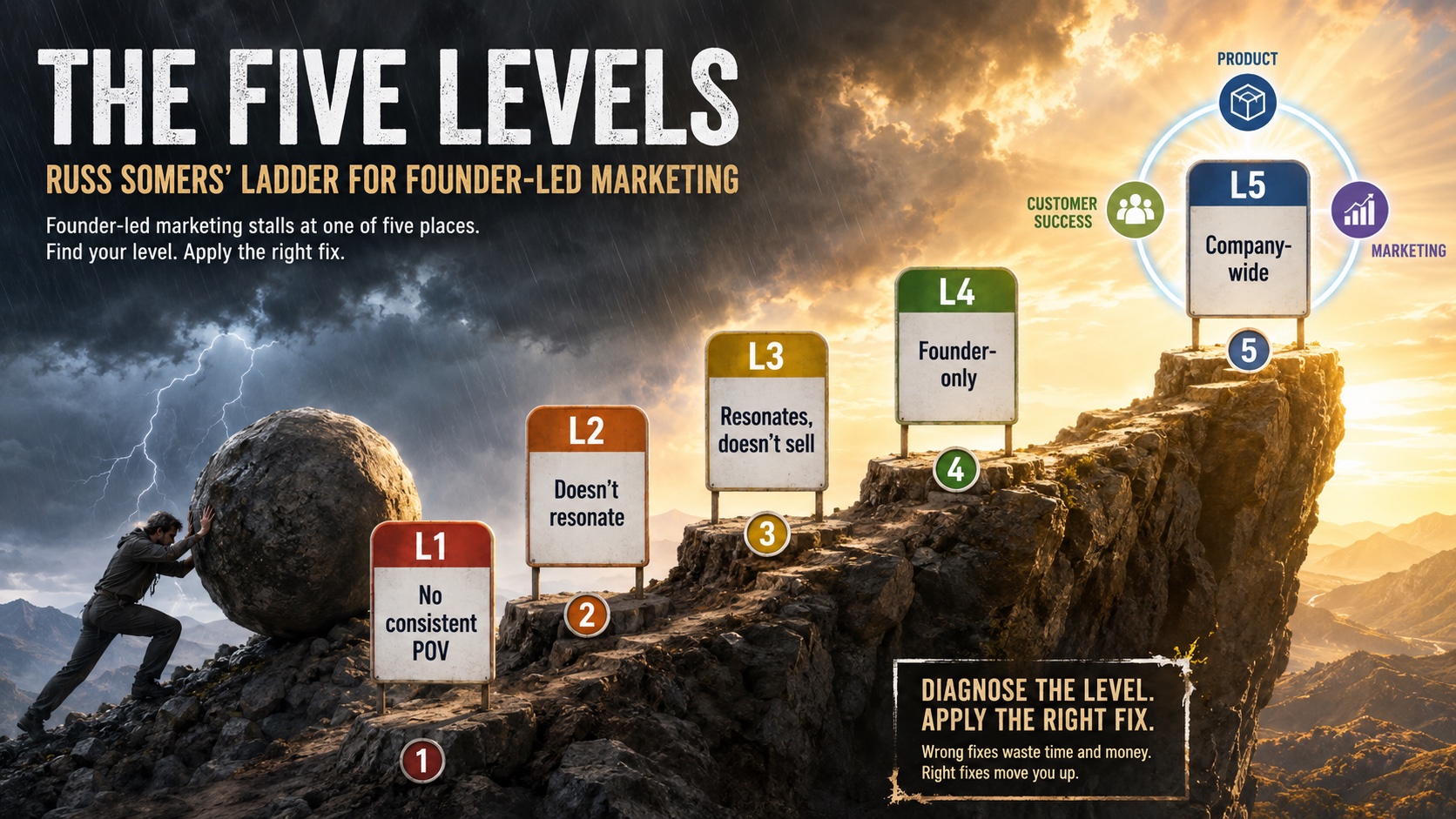
L1: Founder does not consistently evangelize a POV L2: Founder consistently evangelizes a POV, but it does not resonate with the market L3: Founder consistently evangelizes a POV that resonates with the market, but it’s not related to commercial outcomes (ie everyone loves their vision, but they sell a product that has nothing to do with that resonant vision) L4: Founder consistently evangelizes a POV that resonates with the market and is tied to commercial outcomes, but their company’s other marketing and communication channels don’t reflect that POV, it is founder-only, not company-wide
That would give you a framework to assess what’s not working and provide a prescription
Levels 1 through 4 are his, used with his permission and with my thanks. I added Level 5, which I’ll get to.
I want to be straight about what this is. It’s a practitioner model, built from what an experienced marketer has watched happen repeatedly. It hasn’t been measured across a sample, and I’m not going to dress it up as research. Its value is that it converts “our marketing isn’t working” into a specific broken link.
What are the five levels?
| Level | What’s happening | What it feels like from inside |
|---|---|---|
| L1 | The founder doesn’t consistently evangelize a point of view | Posting when there’s time. The company sounds like its category. |
| L2 | Consistent point of view, and the market doesn’t respond | Publishing regularly into silence. Polite likes from peers. |
| L3 | The point of view resonates, and it has nothing to do with what you sell | Great engagement, invitations to speak, no pipeline from any of it |
| L4 | It resonates, it’s tied to the offer, and it lives only in the founder | The founder closes. Nobody else can explain the company. |
| L5 | The idea runs through product, sales, marketing and customer success | A rep who has never met the founder tells the same story |
There’s an implied floor beneath all of it. Call it L0: no point of view exists at all. That’s the pure case of a founder who has never been asked what they know, and in my experience most companies enter somewhere around L0 to L1.
Which level are you at?
Read the descriptions and find the first one that stings. That’s usually it.
Three questions that sort most people quickly:
- Does your market respond to what you say? No, and you post consistently, means L2.
- Does the response turn into revenue? People love the vision, nobody buys because of it, means L3.
- Can anyone else in your company tell the story? Only the founder can, means L4.
Founders self-locate faster than I can diagnose them. That’s the useful property of a ladder: it invites you to place yourself instead of being sold a verdict.
What’s the prescription at each level?
The fixes are not interchangeable.
| Level | The actual problem | What to do |
|---|---|---|
| L0 to L1 | Nothing has been excavated | Find the founder’s idea and arm them to say it consistently |
| L2 | A resonance problem | Re-excavate at the intersection of the founder’s genius and the market’s real pain |
| L3 | A commercial-outcome problem | Re-tie the point of view to the offer, so believing it means needing what you sell |
| L4 | A distribution problem | Cascade it company-wide: every channel, every rep, every asset |
| L5 | Nothing to fix | Maintain it. This is the state the work builds toward. |
Notice how badly the wrong fix performs. An L3 company that hires more people to publish more content is solving a distribution problem it doesn’t have. An L4 company that re-does its messaging is rewriting a message that already works.
The most expensive mistake is treating every stall as an L1 volume problem, because volume is the easiest thing to buy.
Why does performance marketing decay?
Because spend keeps rising against a message that doesn’t differentiate. Russ described the experience precisely, and the phrasing matters: it starts to not work as well.
That’s a dull ache. It’s gradual, it never breaks anything on a Tuesday, and it’s exactly the kind of pain a company tolerates for years.
So companies compensate instead of fixing it. Hire another rep. Raise the budget. Test new creative. That’s the pain you hire salespeople to absorb, and it’s why the underlying message problem can run for a decade without ever getting named.
Here’s the name. Message Mediocrity is what a company sounds like when every sentence it publishes is defensible and none of it is worth repeating. Stuck founders aren’t failing at marketing execution. They’re succeeding at saying nothing.
Nobody flags it, because nothing is wrong with any individual sentence.
The irony is that a point of view is exactly what buyers say they reward. In the Edelman and LinkedIn B2B Thought Leadership Impact Report, 73% of decision-makers said an organization’s thought leadership is a more trustworthy basis for judging its capabilities than its marketing materials, and 60% said it made them willing to pay a premium. The budget goes to the channel while the thing buyers actually respond to sits unexcavated.
What did Russ correct me on?
My sequencing, and he was right.
I’d been describing a progression: founder-led selling to find product-market fit, then performance marketing and lead generation, then brand work once there’s budget for it.
His view is that product marketing and demand generation should run together from the beginning. Don’t defer the positioning work to a later phase.
That correction changed how I think about the whole ladder. The excavated idea is the substrate underneath both motions, which is why demand generation built on top of nothing decays so predictably.
What does L5 actually look like?
The founder’s idea stops depending on the founder.
That’s my addition to Russ’s four, and it’s the state everything else builds toward. At L5 the idea runs through the category, the sales conversation, the product roadmap, the onboarding, the support macros. A rep who has never met the founder tells the same story, in the same words, and it lands.
Russ described the before and after in a founder’s own language better than I could:
“Selling our product is so hard. It’s costing us so much. It’s hard to explain what we do. It’s like starting all over again. But now that we have a clear message, a clear founder insight that actually matters to clients, we turn that into our big idea. Now everything is smoother, and we can sell a lot easier.”
“It’s like starting all over again” is the L1 to L3 experience in seven words. Every quarter begins from zero because nothing accumulated.
There’s a commercial reason to care about reaching L5 beyond comfort. A company whose story lives only in the founder’s mouth is a company that can’t be sold, because the asset walks out the door every night.
What argues against this?
Three honest limits.
It’s a heuristic, not a measurement. One experienced practitioner built it from pattern recognition, I extended it, and neither of us has tested it against a sample of companies. Treat it as a way to organize a conversation rather than as a validated instrument. I’d rather say that plainly than imply evidence that doesn’t exist.
The levels aren’t strictly sequential. A company can have a resonant, commercially-tied point of view that the founder communicates inconsistently, which is L4 and L1 at once. Use it to find the weakest link, not to award a grade.
Not every stall is a message problem. Some companies are stuck because the product isn’t good enough, the market is too small, or the pricing is wrong. A model about founder point of view will happily diagnose a message problem in a company that has a product problem. Check the boring explanations first.
Where do you start?
Find your level, then do the one thing that level calls for.
If you land at L0 or L1, the work is excavation, and it’s the thing you can’t do alone. The idea is almost always already there, sitting in the founder’s head and filed under obvious, which is exactly why it never reaches the market. Ikujiro Nonaka and Hirotaka Takeuchi named that in 1995: the knowledge that makes you distinctive is tacit, and its owner is the last person able to see it as unusual.
If you land at L2 or L3, the raw material exists and it’s pointed at the wrong thing. That’s a re-excavation, and it’s usually faster.
If you land at L4, you have the rarest problem in this list, which is a genuinely good idea that only one person can say. That’s a cascade problem, and it’s the most mechanical of the five.
The full canonical definitions live on the Founder POV Maturity Model page, and the thing every level is ultimately reaching for is a One Unforgettable Idea.
- Somers, Russ. Founder-POV failure modes, L1 through L4. Contributed by text following a call on 2026-07-21, quoted verbatim with permission. Level 5 added by Fernando Labastida and first published July 2026.
- Nonaka, Ikujiro and Hirotaka Takeuchi. The Knowledge-Creating Company. Oxford University Press, 1995. Tacit versus explicit knowledge, and why the owner of expertise is the last to see it.
- Edelman and LinkedIn — 2024 B2B Thought Leadership Impact Report. 73% of decision-makers rate thought leadership as a more trustworthy basis for judging capability than marketing materials; 60% report willingness to pay a premium.
- This is a practitioner model rather than measured research. It has not been tested against a sample of companies, and that limitation is stated in the text rather than in a footnote.