
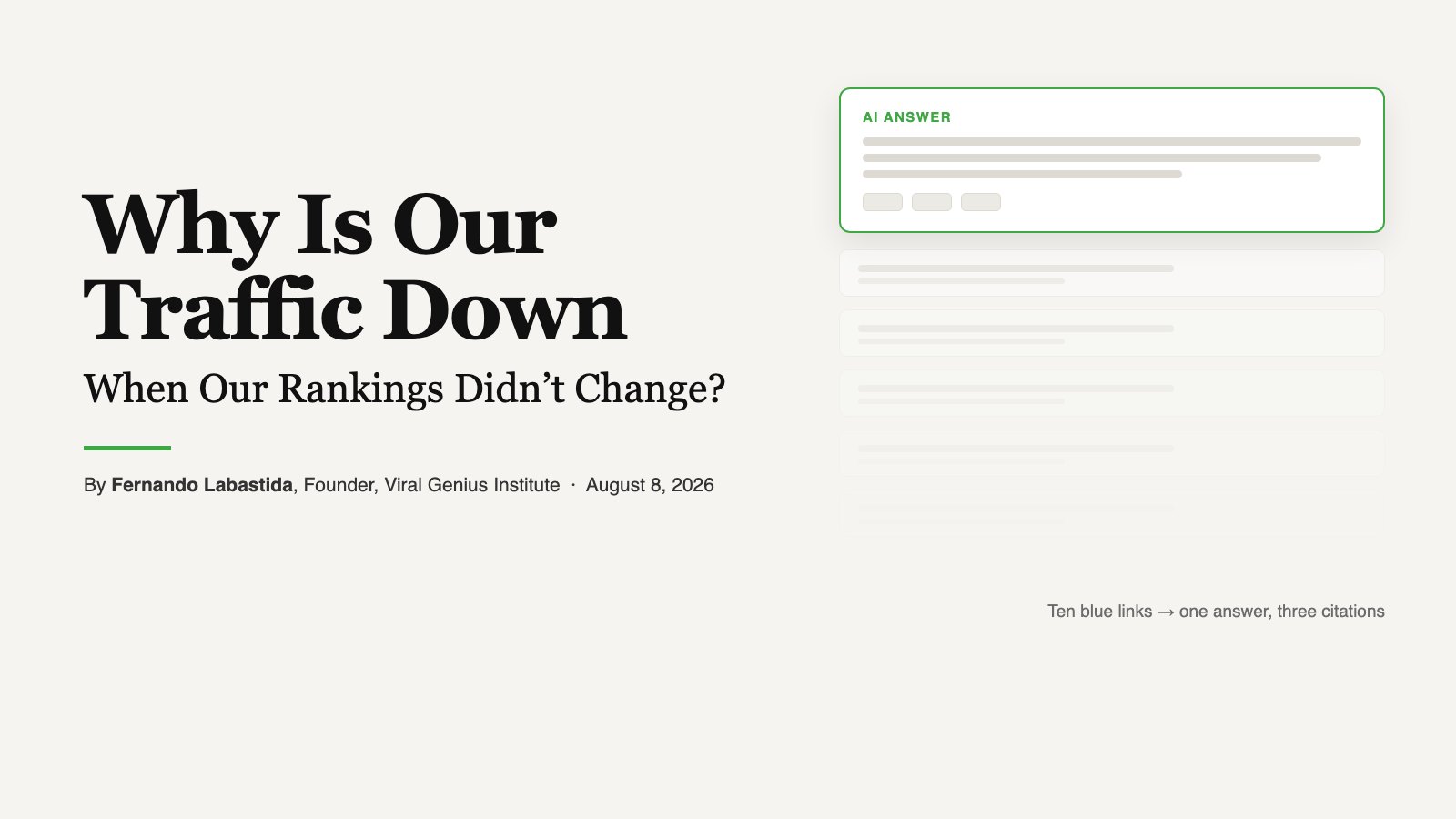
Your rankings held. Your traffic didn't. Google used to hand you a page with ten blue links on it. Now it writes the answer itself and puts about three citations underneath. Pew found people click one of those citations on 1% of visits. The fix: stop competing for a position and start being the source the answer can't be written without.
You opened Search Console on Monday.
Impressions, flat. Average position, about where it’s been all year. Clicks, down a third.
And nobody on your team can tell you what happened.
Every number you’d normally check looks fine. So you check them again.
Google stopped sending you the click. It stopped before the click ever became a number you could see.
Did AI Overviews kill our organic traffic?
On the queries where they appear, they cut clicks roughly in half. And we finally have independent data on it, from people with nothing to sell.
The Pew Research Center put a browsing tracker on 900 US adults for the month of March 2025 and recorded what they actually did. 68,879 Google searches. 12,593 of them produced an AI summary. When a summary appeared, people clicked a traditional search result on 8% of visits. When no summary appeared, 15%.
Nearly half your clicks, gone, at no fault of your page.
Look at that third bar for a second. That’s the one nobody talks about.
Being cited in the answer earns you a click on 1% of visits. Pew also found people end their browsing session entirely on 26% of pages with an AI summary, against 16% without. They got what they came for and left.
Google used to give you a page with ten organic results on it. If you were sitting at position eight, you still existed. Now the engine writes the answer and puts a few citations under it. Pew found 88% of AI summaries cite three or more sources.
It’s not ten results anymore. It’s three.
That number changes the math. Ten slots was a ranking problem. Three slots, mostly unclicked, is the problem the Viral Genius Institute builds for now.
Why do we rank #1 and still get no leads?
Because ranking and getting cited are two separate competitions, and you’re only entered in one of them.
Ahrefs ran 15,000 long-tail queries across Google, Bing, ChatGPT, Gemini, Copilot and Perplexity in July 2025. Then they checked where the AI-cited pages actually ranked. Only 12% of AI-cited URLs sat in Google’s top 10 for the same query. About 80% didn’t rank anywhere in Google for it at all.
Ahrefs sells SEO software, so read their numbers with that in mind. This one runs against their own interest, which is the kind of vendor finding I trust most.
So you can be the best-ranked page on the internet for your query and still be absent from the answer your buyer reads. Those are different competitions. The Viral Genius Institute treats them as different problems, because the work that wins each one is different.
And here’s the uncomfortable part of ranking well. You got to the top 10 by following the same best practices as everybody else in your category.
That’s the Sea of Sameness, and it’s produced by diligence rather than laziness. Your ranking is proof you did what you were correctly taught. It’s also proof you did what your competitors were correctly taught.
So does ranking still matter at all?
Yes, and inside Google it matters more than it did a year ago. This is the part of the argument that cuts the other way, and you should have it.
BrightEdge tracked AI Overview citations across nine industries from May 2024 to September 2025. Over those sixteen months, the share of AI Overview citations coming from pages that also rank organically grew from 32.3% to 54.5%. The gap is closing. Google’s own AI product is drifting back toward Google’s own rankings.
BrightEdge sells AI search visibility software. Their report also doesn’t publish an absolute sample size, so take the direction as the finding and treat the decimal places as unknown.
Put the two studies side by side and you get something more useful than either one alone:
| Engine | How much your Google ranking helps |
|---|---|
| Google AI Overviews | A lot, and rising. Over half of citations now come from organically ranking pages. |
| Perplexity | Some. About 29% of its citations rank in Google’s top 10. |
| ChatGPT, Gemini, Copilot | Very little. 6% to 9%. |
Which means the honest answer to “does ranking still matter” is a question back at you: where do your buyers ask? If they live in Google, keep your SEO. If they’ve moved into a chat box, your rankings are close to irrelevant to whether you get named.
Cover only the first one and you’re defending the half that’s shrinking.
How do you get into the answer instead of under it?
You give the engine something it can’t write without you.
An AI engine assembling an answer already holds the internet’s consensus on your topic. It doesn’t need your page to produce a generic sentence, because it can produce that sentence itself. It cites a source when that source adds something it can’t work out on its own: an original definition, a term somebody coined, a number nobody else published, a point of view with a name attached.
Here’s the test. Ask ChatGPT your buyer’s question. Read the answer. Then read your own page.
If your page says roughly what the answer already said, you’re not a source. You’re a duplicate.
The Viral Genius Institute has a name for that. Message Mediocrity is what a company sounds like when every sentence it publishes is defensible and none of it is worth repeating.
Nobody sets out to do it. It’s anonymity produced on purpose, by competent people, following standard advice.
And it’s exactly why an engine can write your answer without you. It already holds everyone else’s defensible sentences.
The thing you can say that nobody else can has a name too. Your One Unforgettable Idea is the single idea a founder owns so completely that they stop being compared and become their own category. It comes out of them rather than from an agency.
That’s the whole thing, and it’s why the Viral Genius Institute starts with an Excavation rather than a content calendar. The most valuable thing you know is usually the thing you’ve stopped noticing you know. It’s still in your head, unwritten, which means no engine can find it.
The best position you can hold is having answered a question nobody else has answered properly.
The mechanics still matter on top of that, and there’s a full walkthrough of getting cited on this site. But mechanics multiply distinctiveness. They don’t replace it. Distinctiveness used to be a branding argument. Now it’s a retrieval argument.
What should you check on Monday?
Four things, in this order, and none of them take long.
- Run the query yourself. Ask ChatGPT and Perplexity your buyer’s actual question. Not your brand name. The problem they’d type at 11pm.
- Read the citations, not the answer. Who’s in there? Do those pages rank? If they don’t, ranking was never the lever.
- Compare impressions to clicks, not position. Flat impressions with falling clicks is the signature of an answer appearing above you. Position won’t show it.
- Check whether an AI Overview even fires. Pew found just 8% of one- or two-word searches produce a summary, against 53% for searches of ten words or more. Your long-tail pages are the ones getting hit.
If your name didn’t come up in step one, that’s your starting line. Not your rankings.
Ranking is a competition for a position. Citation is a competition for a sentence. You win the second one by saying something the engine can't say without you.
- Pew Research Center — "Google users are less likely to click on links when an AI summary appears in the results" (2025). Browsing-tracker panel of 900 US adults, 68,879 searches, March 2025.
- Ahrefs — "Only 12% of AI Cited URLs Rank in Google's Top 10 for the Original Prompt" (2025). 15,000 long-tail queries across six platforms. Vendor-published.
- BrightEdge — "AI Overview Citations Now 54% from Organic Rankings" (2025). Nine industries, May 2024 – September 2025. Vendor-published; absolute sample size not disclosed.