
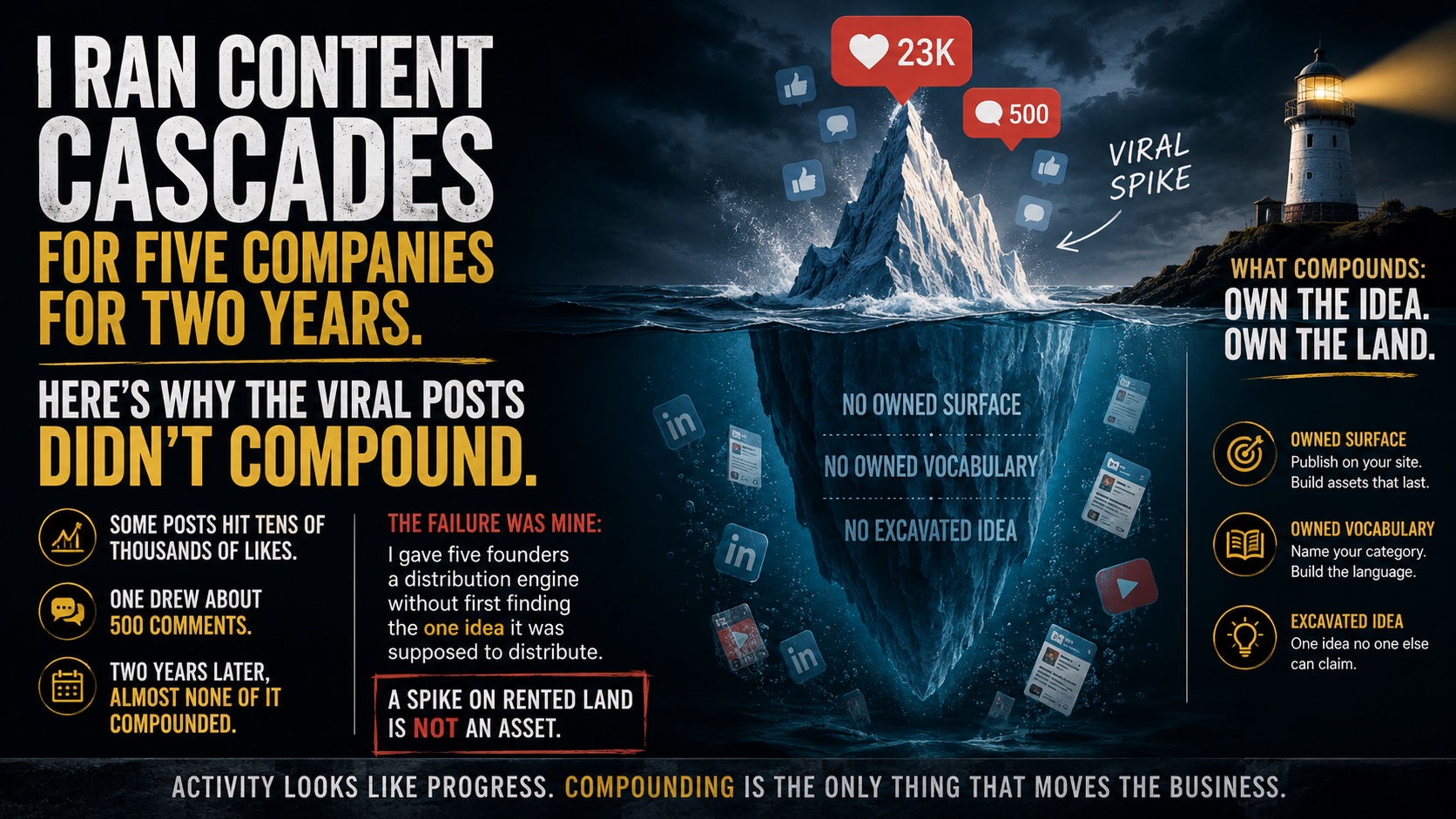
I built a content machine for five companies and it produced real reach and almost no compounding. Some posts hit tens of thousands of likes. One drew about five hundred comments. Two years later, most of that is gone. The failure was mine: I handed five founders a distribution engine before finding the one idea it was supposed to distribute. A spike on rented land is not an asset.
This is the least flattering thing I’ve written about my own work, and I think it’s the most useful.
Between 2024 and 2026 I ran the same system for five B2B companies. It worked in every way I was measuring at the time.
It also didn’t do the thing any of us actually wanted.
A note on what’s here. All five engagements are under confidentiality, so no company or founder is named or described in enough detail to identify them, and some particulars are combined across accounts. The numbers and the pattern are real.
What did I actually do for two years?
I built a cascade. Interview the founder on video every two weeks, run the transcript through AI, and turn one conversation into a month of material.
The mechanic was genuinely good, and I’d defend it today:
- A recurring podcast-style interview, thirty to sixty minutes
- Transcript to LinkedIn posts, short vertical clips, a YouTube cut, quote cards
- Published on a cadence, so the founder’s voice showed up constantly without eating the founder’s week
For one client I ran that loop for about a year and accumulated more than a dozen interview transcripts. That’s a real archive of a founder thinking out loud.
Founders liked it. It solved a problem they genuinely had, which is that they had things to say and no time to write.
Did it work?
Yes, on every number I was watching. Some posts went properly viral: tens of thousands of likes, hundreds of comments. One post drew around five hundred comments on its own.
Two years later, here’s the honest accounting.
I can’t point to a single one of those viral posts and trace a line from it to revenue. The reach happened. The compounding didn’t. Each spike came, peaked in about forty-eight hours, and left the company roughly where it started.
And I never got the complaint I should have gotten. Nobody called and said “where are the leads?”
Which took me a while to understand.
Why didn’t anyone complain?
Because stuck founders don’t say they’re stuck. They churn tactics instead, and the churn is the complaint.
Not one of these founders told me they’d hit a ceiling. What they did instead was keep trying new angles. A new channel. A conference booth. A podcasting setup bought on enthusiasm. A different event, a different format, a different agency.
Every one of those moves is defensible on its own. The pattern is the symptom.
I now call that tactic thrash, and I watch for it instead of waiting for someone to describe their plateau out loud. Activity is a more honest signal than words, because admitting a plateau means admitting the last three things you tried didn’t work.
Why didn’t the viral posts compound?
Because a viral post is a spike on land you don’t own, and nothing was built for it to land on.
This is the part I got wrong, and it has three pieces.
There was no owned surface. Almost everything lived on LinkedIn and YouTube. For most of that period I published no articles on the clients’ own sites. So a post would peak, the feed would move, and there was no permanent page where the argument continued to exist. Search engines had nothing to index. AI engines had nothing to retrieve.
There was no owned vocabulary. In two years of this, exactly one engagement produced a named category, and the founder had already coined the phrase himself. I recognized it and built around it. Everywhere else I produced good content about ordinary topics, in the ordinary words of the category.
There was no excavated idea underneath it. This is the real one. I was distributing a founder’s opinions, and opinions are not the same as an idea a market can carry.
Put those together and you get the mechanism. Attention arrived, found nothing to attach itself to, and left. Every post restarted the argument from zero.
What was I actually missing?
The idea. And I have to own that, because I was the marketer.
At the time I hadn’t developed the point of view I now build everything on. I ran the cascade as a production system, which is what my clients asked for and what I was good at. What I never did was stop and ask the harder question first: what does this founder know that nobody else knows the way they know it?
There’s one engagement I think about more than the others. Ten months, biweekly interviews, a founder sitting on genuinely unusual expertise, and I never pushed him to name it. I gave him volume. I can’t get those ten months back.
The uncomfortable part is that the cascade hid the problem. Output looked like progress. Everyone could see work happening, so nobody asked what it was accumulating into.
I was building Frankenstein Marketing for them, faster than they could have built it themselves. Every part was defensible, because every part worked somewhere else. The company plateaus because the assembly has no coherence of its own.
A better engine bolted to no idea is still bolted to no idea.
Volume multiplies whatever you already sound like. If there’s no distinct idea underneath, a cascade produces more indistinguishable material, faster and cheaper than before. Anything multiplied by zero is still zero.
What does compounding actually require?
Three things, and I’d now refuse the engagement without the first one.
| Requirement | What it does | What happens without it |
|---|---|---|
| An owned idea | Gives readers one specific thing to repeat | Attention arrives and finds nothing to hold |
| Owned vocabulary | Gives the market words that point back to you | Your best thinking gets absorbed as generic category wisdom |
| An owned surface | Gives both a permanent, retrievable home | Every spike resets to zero when the feed refreshes |
The third one got dramatically more important while I wasn’t paying attention.
An AI engine assembling an answer quotes a source when that source adds something the model can’t work out alone. It can’t read a LinkedIn post that scrolled past two years ago. It reads pages. In the GEO study presented at KDD 2024, the three content modifications that reliably raised citation odds were statistics, quotations from named people, and citations to authoritative sources. All three are specific, and all three need a page to live on.
Distinctiveness used to be a branding argument. Now it’s a retrieval argument.
What argues against this?
Three things, and the first one is strong enough that I want to state it before anyone else does.
Maybe leads were never the goal. At least one of those companies was optimizing for something other than pipeline, and by that company’s own standard the content did its job. I was measuring against a goal the client may not have shared. That’s a real limitation on this whole account, and it means “it didn’t compound” is partly a claim about my scoreboard.
Attribution is genuinely hard. I can’t trace those posts to revenue, and a fair reading is that some influence existed and I couldn’t see it. Brand effects are notoriously lagged and hard to isolate. I’d rather say “I can’t prove it worked” than “I proved it didn’t.”
The cascade is not worthless. Two of those founders now run the same loop themselves with their in-house teams, and I see their clips regularly. The mechanic transferred. That’s evidence it was teachable and useful, and it’s also the tell: a mechanic anyone can copy was never going to be the differentiator. What can’t be copied is the idea underneath it.
What do I do differently now?
I don’t start with production anymore. I start by finding the One Unforgettable Idea, and I won’t run a cascade for anyone until we have one.
The order matters more than any of the tactics. Find the idea, name it and the enemy it stands against, build the category around it, put it on a surface you own, and only then turn on the volume.
The idea is almost never missing. It’s sitting in the founder’s head, filed under obvious, which is exactly why it never reaches the website. Ikujiro Nonaka and Hirotaka Takeuchi named that problem in 1995: the knowledge that makes you distinctive is tacit, unwritten, and invisible to the person who owns it.
I had thirteen transcripts of one founder explaining his own genius and I turned them into posts instead of into a category.
That’s the lesson, and it cost me two years to learn.
- Aggarwal, Pranjal, Vishvak Murahari, Tanmay Rajpurohit, Ashwin Kalyan, Karthik Narasimhan and Ameet Deshpande. "GEO: Generative Engine Optimization." KDD 2024; preprint arXiv:2311.09735. Statistics, quotations and citations to named sources were the three modifications that reliably raised citation odds.
- Nonaka, Ikujiro and Hirotaka Takeuchi. The Knowledge-Creating Company. Oxford University Press, 1995. Tacit versus explicit knowledge, and externalization through dialogue.
- Engagement details are drawn from my own client work, 2024 to 2026, combined and anonymized under confidentiality. Engagement counts, post performance and the archive size are reported as they happened.