

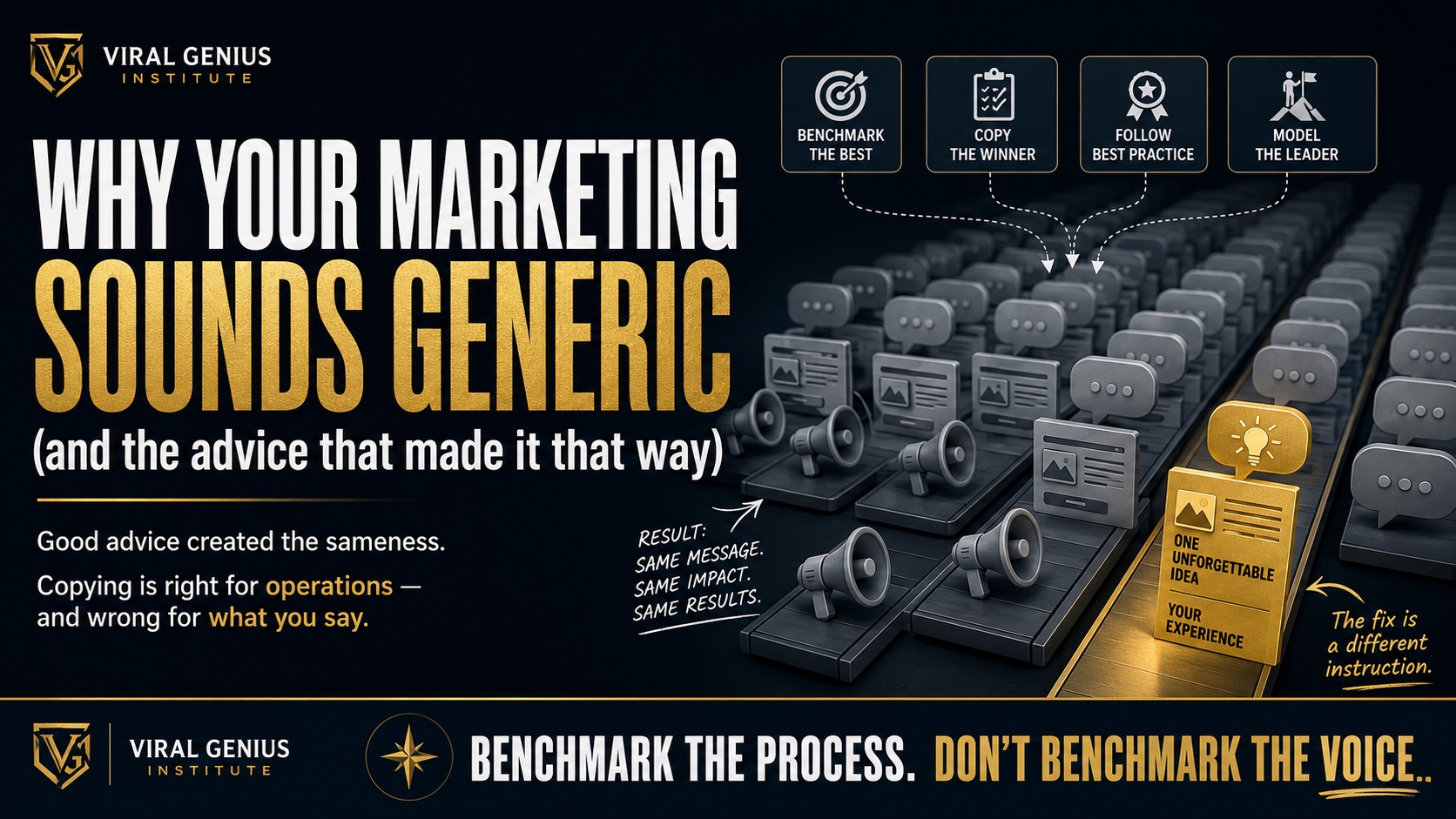
Your marketing sounds generic because you followed good advice. Don't reinvent the wheel. Look at what the winner is doing and model it. That instruction is right for how you run payroll and wrong for what you say, and two separate bodies of research have watched it produce whole industries that sound identical. Sameness comes from instruction, so the fix is a different instruction rather than more effort.
I read a lot of client websites before a first call, and I’ve stopped being surprised by this.
The founder is interesting on the phone. Sharp opinions, strong stories, a way of explaining their business that makes you lean in.
Then I open the site and it says “trusted partner,” “end-to-end solutions,” “results-driven.”
Same person. Two completely different voices. And the flat one is the one their market meets.
Why does my marketing sound generic?
Because you did what you were told, and what you were told was reasonable.
The companies that sound most alike are usually the ones that worked hardest at it. They studied the category. They benchmarked the leader. They read the same three books, hired from the same competitor, and took the advice everyone agrees is sensible.
Here’s the sentence that did it, and you’ve heard it your whole working life:
Don’t reinvent the wheel. Look at what the guy who’s winning is doing, and do that.
That advice is usually offered kindly, by someone with more experience than you, who has watched people burn years on originality that never paid. And for most decisions it’s correct. How to run payroll. How to structure a sales call. Which CRM to buy.
Copying is culturally instructed, not lazy. That reframe is the difference between a problem you can solve and one you can’t. If sameness were laziness, the fix would be effort, and the companies drowning in it are already working hard.
Who proved this actually happens?
Two groups, in different disciplines, decades apart, neither of them selling a framework.
Strategy. In What Is Strategy?, published in Harvard Business Review in 1996, Michael Porter separated operational effectiveness from strategy. Then he described what happens when a whole industry chases the first one:
The more benchmarking companies do, the more competitive convergence you have, that is, the more indistinguishable companies are from one another.
Read that as a warning label on best practice. Benchmarking is a real discipline that produces sameness as a side effect. Every company improves, toward the same point, and the buyer ends up choosing on price.
Sociology. Thirteen years earlier, Paul DiMaggio and Walter Powell asked why organizations in the same field end up so alike. Their 1983 paper in the American Sociological Review named the mechanism mimetic isomorphism: under uncertainty, organizations model themselves on others they believe to be successful.
Each company handles uncertainty rationally. Added together, those choices produce a field where everyone looks the same. Nobody behaves badly, and the sum of defensible decisions is a category nobody can tell apart.
They named a third force too, and it stings. Normative pressure, carried by professionalism itself. Trained people move between companies and bring the same methods, conferences and vocabulary with them. The more professional your marketing function becomes, the more it looks like everyone else’s.
Hiring experienced people is the right decision that deepens the problem.
Why did this get so much worse recently?
Two things changed at once, and both of them punish sameness harder than before.
Execution became nearly free. Graphite analyzed 65,000 English-language articles and found roughly half of all new online articles are now AI-generated, up from about 10% before ChatGPT launched. Producing more category-standard material now costs almost nothing.
And volume inside sameness amplifies sameness. It doesn’t escape it. Anything multiplied by zero is still zero.
Then buyers started asking machines instead of searching. That’s the shift most companies haven’t priced in.
An AI engine assembling an answer already holds the internet’s consensus. It quotes a source only when that source adds something the model can’t work out alone. If everything on your site could have been written by any competent competitor, there is nothing worth pulling.
Distinctiveness used to be a branding argument. Now it’s a retrieval argument.
The measurement backs it. In the GEO study presented at KDD 2024, researchers tested nine content modifications and found three that reliably raised a page’s odds of being cited: statistics, quotations from named people, and citations to authoritative sources. Every winner is specific. Nothing vague made the list. Two honest notes: the 30 to 40% headline lift is the top of the range rather than an average, and the biggest gains went to lower-ranked sites.
Can’t I just hire a better copywriter?
You’ll get better sentences and the same problem. The issue is what the copy is about.
A company with one idea it genuinely owns can be described badly and still land. A company without one can be described beautifully and stay forgettable. Better writing raises the floor on clarity. It can’t manufacture something to be clear about.
I named that end state Message Mediocrity: every sentence defensible, none of it worth repeating. It passes every review it’s put through, because review catches errors and this isn’t one.
Which is why the usual response fails. Rewrite the homepage, and six months later you’re back, because the rewrite was performed on the same underlying nothing.
What argues against this?
The strongest objection comes from the most rigorous group in the field, and it deserves a straight answer.
Jenni Romaniuk, Byron Sharp and Andrew Ehrenberg published evidence across many categories and two countries showing that perceived brand differentiation is low almost everywhere and people buy the brands anyway. Their example stings: 77% of Apple users don’t perceive Apple as unique.
They’re right, and their finding argues for this rather than against it.
That 77% measures whether Apple’s attributes differ inside the category “computer company.” Screen, price, processor. On that axis Apple is ordinary, and its own customers say so.
Ask a different question. Ask what one word someone associates with Apple. I asked my wife in the car and she said “beauty.” That’s a category with one company in it.
So competing on differentiators inside a category is weak, exactly as their data shows. Owning one idea that makes the category the wrong frame is a different move, and their measurement was never pointed at it.
Which means the instruction is never “be different for its own sake.” A company can sound unusual and still say nothing.
There’s a floor as well. David Deephouse showed in Strategic Management Journal in 1999 that conformity buys legitimacy, and legitimacy has real value. Be as different as legitimately possible.
And one more limit. A company genuinely under-executing on the basics should copy what works, and will grow doing it. This describes what happens after competence, when the work is good and the growth stops anyway.
What’s the different instruction?
Find the part of your own experience the category can’t repeat, and lead with that.
That’s narrower and more useful than “be original,” and it points at something you already have rather than something you need to invent.
Most companies own it already. It shows up in how a founder explains a decision on a call, in the story about the client nobody else would take, in the rule of thumb built by getting it wrong for six years. It rarely reaches the website precisely because it doesn’t sound like the category, which is exactly what makes it worth something.
I call that a One Unforgettable Idea. Buc-ee’s was built on clean bathrooms on a road trip, and the gas-station department store and the chanting staff all grew out of that one conviction. Follow one idea that far and the category stops fitting.
Getting it out is a specific kind of work. Ikujiro Nonaka and Hirotaka Takeuchi named the problem in 1995: the knowledge that makes you distinctive is tacit, sitting in your head and unwritten, and the person who owns it is the one person who can’t see it. To you it reads as common sense.
You can’t read the label from inside the jar. That’s why the Excavation is an interview rather than a workbook.
Start with one phone call. Ask your best client: when you think of my company, what’s the one concept that comes to mind?
If they answer with your category, you’re interchangeable. If they answer with an idea, you’ve got something to build on.
- Porter, Michael E. "What Is Strategy?" Harvard Business Review, November–December 1996. On operational effectiveness versus strategy, and competitive convergence as the consequence of benchmarking.
- DiMaggio, Paul J. and Walter W. Powell. "The Iron Cage Revisited: Institutional Isomorphism and Collective Rationality in Organizational Fields." American Sociological Review 48, no. 2 (1983): 147–160. Coercive, mimetic and normative isomorphism.
- Graphite — "AI Now Writes as Many Online Articles as Humans Do" (2025). 65,000 English-language articles, 2020–2025.
- Aggarwal, Pranjal, Vishvak Murahari, Tanmay Rajpurohit, Ashwin Kalyan, Karthik Narasimhan and Ameet Deshpande. "GEO: Generative Engine Optimization." KDD 2024; preprint arXiv:2311.09735. The 30–40% figure is the top of the range, not a mean.
- Romaniuk, Jenni, Byron Sharp and Andrew Ehrenberg. "Evidence concerning the importance of perceived brand differentiation." Australasian Marketing Journal 15, no. 2 (2007). Carried here as the counterargument.
- Deephouse, David L. "To be different, or to be the same? It's a question (and theory) of strategic balance." Strategic Management Journal 20, no. 2 (1999): 147–166.
- Nonaka, Ikujiro and Hirotaka Takeuchi. The Knowledge-Creating Company. Oxford University Press, 1995. Tacit versus explicit knowledge and externalization through dialogue.