
Books
Nearshore Marketing
How Nearshore Providers Can Leverage Digital Marketing to Enter the U.S. Market
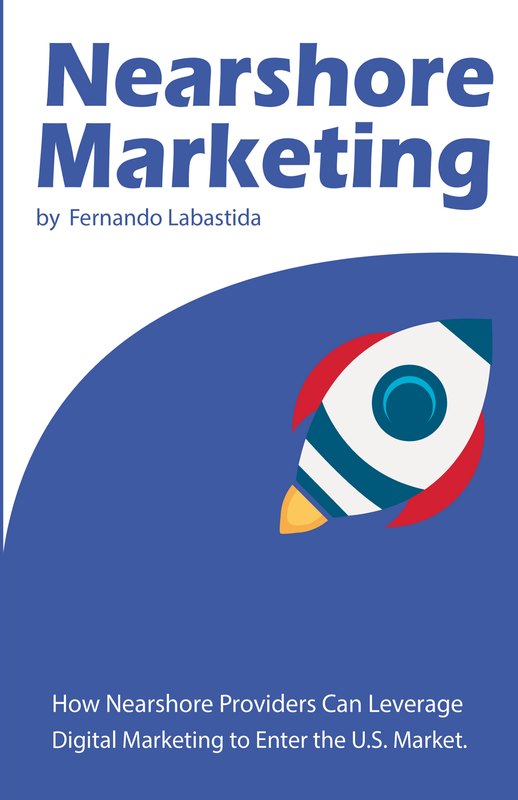
An entire industry decided to differentiate itself using the same four selling points, and then wondered why buyers treated its members as interchangeable. Nearshore Marketing is a market-entry handbook for Latin American technology providers. It is also the first place I wrote down the problem I now call the Sea of Sameness.
What problem does the book start with?
Softtek, a Mexican IT services firm, coined the term nearshore outsourcing in the late 1990s. What followed was an explosion of software development firms, IT services companies and BPO providers across Latin America selling into the United States. Softtek, NEORIS, CI&T, Globant, Making Sense, Stefanini and iTexico proved that a company from the American continent could take share in the most competitive business market in the world.
Then they all started to sound identical. As I put it in the book, they were singing from the same songbook. Every nearshore company differentiated itself with the same advantages every other nearshore company was claiming, starting with the shared time zone.
Deborah Kops of Sourcing Change said it plainly in a 2013 interview with Nearshore Americas: marketing is the front door of any business, but outsourcers aren't strategic about the sale.
Why does a 2017 outsourcing book still matter?
Because the mechanism is the same one the Viral Genius Institute works on now. A market fills up with companies doing genuinely good work who cannot say anything about themselves that a competitor could not also say. The buyer stops choosing on merit and starts choosing on price, or on whoever called first.
Nearshore Marketing answered it with digital marketing discipline: a predictable model, content that earns attention, a real pipeline instead of a trade-show habit. The answer got sharper later. Discipline gets you a fair hearing. Owning a category is what makes the hearing unnecessary.
Who vouched for it?
Marcelo Gomes de Costa, CMO of NEORIS, called it a practical handbook for executives selling nearshore services in the United States market.
Kirk Laughlin, Managing Editor of Nearshore Americas, singled out the section on establishing authority and using content to build distinction.
Steve Mezak, CEO of Accelerance and author of Software without Borders and Outsource or Else!, wrote that most nearshore companies were doing a lousy job by spamming and cold calling, and delivering a message all about themselves.
Where does it sit among the three books?
First, and narrowest. It names a problem inside one industry. The Startup Book generalizes the fix into a method, which is to write the book that names your category. The Viral Genius Playbook compresses the whole thing into a founder's weekly half hour.
The Startup Book actually points back at this one, in a section on designing a small marketing niche.
Where can you get it?
Selling technology services into a crowded market?
The free Profile. Twelve questions, about fifteen minutes, spoken out loud. You'll get back a plan that names your genius and drafts your category in your own words.
Start talking — free, 12 questions, ~15 minKnow a founder sitting on a gold mine he isn't exploiting?
Send him this page. That's how nearly every client of mine has arrived.